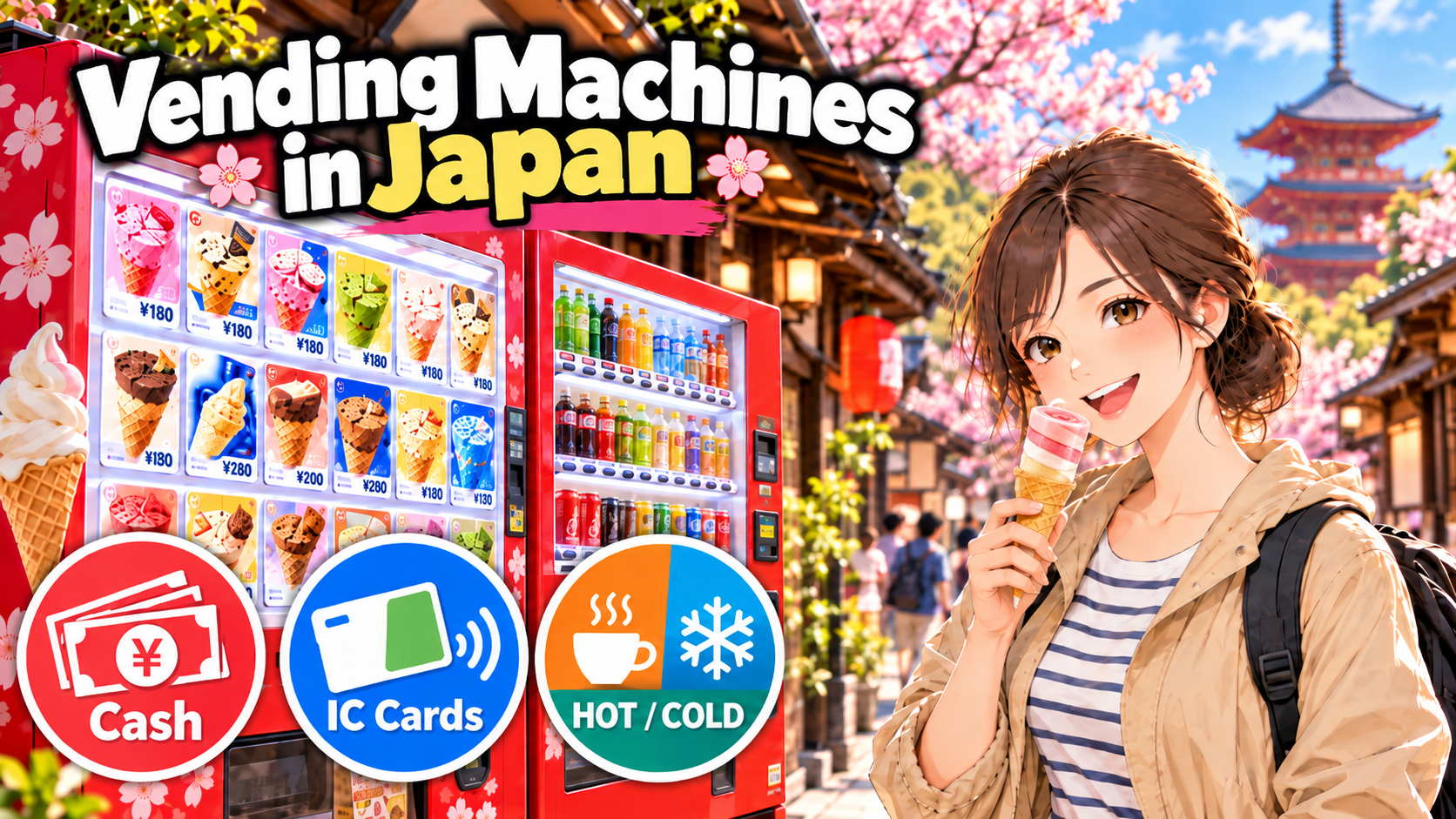
As you travel around Japan, you’ll see vending machines almost everywhere — on train platforms, near hotels, at tourist spots, and on street corners.
They’re convenient when you want a drink right away, but if it’s your first time using one in Japan, you may wonder:
“Which coins and bills can I use?”
“Can I pay with Suica or a credit card?”
“How do I actually use one?”
The short answer is: Japanese drink vending machines are not difficult to use, even if it’s your first time.
- With cash, insert your money, choose a drink, and press the button. If you have change, take it from the coin return slot.
- On a cashless machine, check the available payment methods, select your drink, then tap your card or smartphone to pay.
That’s basically it.
But vending machines in Japan can also be a little more interesting than you might expect.
- Machines that sell hot drinks
- Coke ON machines that connect to your smartphone
- Ice cream vending machines
- Tax-free vending machines
- Cup noodle vending machines on ferries
You may even come across a few that are worth trying just for the experience.
There are vending machines at the summit of Mt. Fuji, too!
In this guide, I’ll walk you through what you need to know when using vending machines during your trip to Japan.
- How to use a Japanese drink vending machine
- Which coins and bills you can use
- Suica, other transportation IC cards, and cashless payments
- What HOT, COLD, 売切, 準備中, and 釣り切れ mean
- How Coke ON works
- Interesting vending machines to look for while traveling
- Where to put your empty bottle or can afterward
Japanese drink vending machines are simple to use
According to the Japan Soft Drink Association, Japan has about 2 million soft drink vending machines.
You’ll find them not only at stations and on city streets, but also in parks, hospitals, schools, offices, and many other places.
The best thing about vending machines is simple:
you can buy a drink immediately without going into a store.
Need water on a hot day?
Want some tea on the way back to your hotel?
Feel like a hot coffee on a cold winter morning?
That’s exactly when a vending machine comes in handy.
One thing to remember: if a vending machine is inside a building, you may not be able to use it after that building closes.
A vending machine is not automatically available 24 hours a day just because it’s a vending machine.
With a Japanese drink vending machine, all you really need to check is the drink you want, the price, and how you can pay.

Vending machines are convenient when you want something right away, but drinks usually cost more than they do at convenience stores.
If you want to save money, use a convenience store. If you want a drink right now, use a vending machine.
Drugstores and supermarkets can be even cheaper, although many of the lowest-priced drinks there are sold at room temperature.
How to buy a drink with cash
Let’s start with cash.
On a typical drink vending machine, the steps are simple.
- Choose the drink you want and check the price
- Insert coins or an accepted banknote
- Press the button for the drink you want
- Take your drink from the dispenser at the bottom
- If you have change, don’t forget to take it
On some machines, the buttons for drinks you can buy light up after you insert your money.
Press the button for the drink you want, and it will drop into the dispenser below.
There’s nothing complicated about it.
Which coins and bills can you use?
On a typical Japanese drink vending machine, you can generally use:
- ¥1,000 bills
- ¥500 coins
- ¥100 coins
- ¥50 coins
- ¥10 coins
For example, standard Coca-Cola vending machines in Japan also accept this combination.
On the other hand:
- ¥5,000 bills
- ¥10,000 bills
- ¥5 coins
- ¥1 coins
are not accepted by a typical drink vending machine.
One thing to watch for:
If you see 釣り切れ near the money slot or display, the machine does not have enough of a particular coin to give you change.
For example, if the ¥10 coin is marked as unavailable, you could still insert ¥200 and buy a ¥150 drink because the machine can return ¥50. But you could not buy a ¥140 drink, because that purchase would require a ¥10 coin in change.

Can you use Suica or PASMO?
If the vending machine accepts transportation IC cards, you can use Suica, PASMO, and other supported cards.
Not every vending machine supports them.
Take a look at the payment area first.
If you see the logo for Suica or another transportation IC card, that payment method is supported.
The exact steps vary a little depending on the payment terminal.
For example, on a machine where you need to select the type of electronic money first:
- Select the drink you want and press its button
- Select the electronic money you want to use on the payment panel
- Tap your IC card or smartphone
- Wait for the payment sound
- Take your drink
That’s the basic flow.
Other machines do not require you to select an electronic payment method first — you can simply tap your IC card.
So if:
“I tapped my Suica, but nothing happened.”
check not only for the transportation IC logo, but also:
whether you need to press a payment-method button first.
Some vending machines also accept credit cards and QR payments
Cashless vending machines are not limited to transportation IC cards.
Depending on the machine, you may be able to use:
- Transportation IC cards
- Other electronic money
- QR code payments
- Contactless credit and debit cards
The available payment methods vary from machine to machine.
Check the logos shown on the payment panel to see what that particular machine accepts.
If you’re already using Suica or another IC card during your trip, you can use it at compatible vending machines too.
Some vending machines still accept cash only, so I recommend keeping a few ¥1,000 bills and some coins with you.
Check the HOT, COLD, 売切, and 準備中 labels
Before choosing a drink from a Japanese vending machine, take a quick look at the labels.
These are especially useful to know:
- HOT: a hot drink
- COLD: a cold drink
- 売切: sold out
- 準備中: temporarily unavailable
- 釣り切れ: the machine cannot give change in a particular coin denomination
In winter, make sure you don’t mix up HOT and COLD

In colder months, the same vending machine may sell both cold and hot drinks side by side.
Before choosing, look for:
HOT (red label)
COLD (blue label)
In winter, you’ll often see hot canned coffee, tea, milk tea, and other warm drinks.
You don’t want to think you’re buying a hot coffee and end up with a cold one instead.
Check the HOT or COLD label before you press the button.
If you visit Japan in winter, look for seasonal drinks too, woof.
Corn soup and oshiruko (おしるこ sweet red bean drink) are both delicious.
売切 means SOLD OUT
売切 means SOLD OUT.
If you see 売切 on or near a product button, you cannot buy that item at that moment.
Choose another drink or look for another vending machine nearby.
You also can’t buy a drink marked 準備中
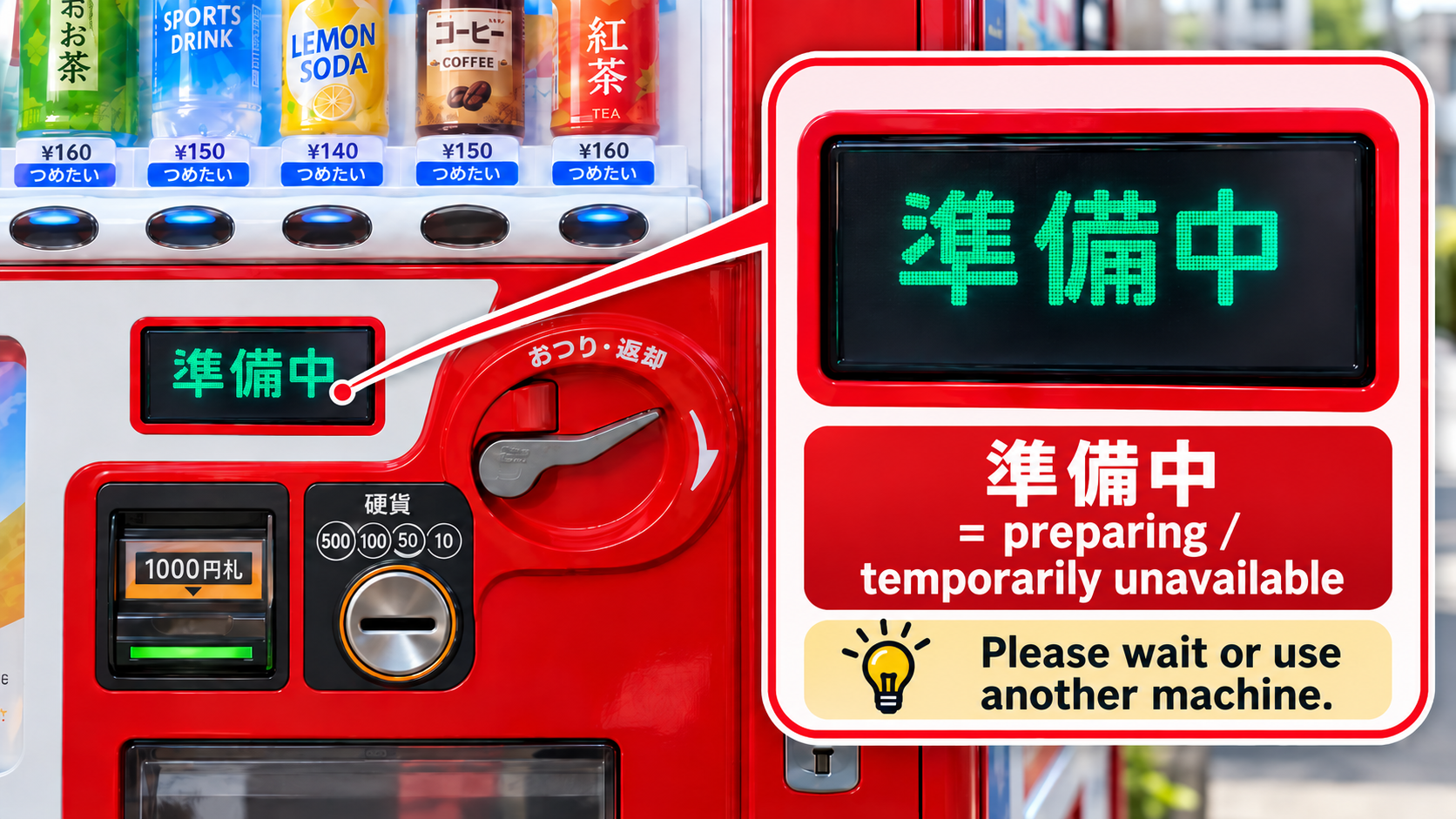
A recently restocked drink may sometimes be marked:
準備中
This means the item is temporarily unavailable.
You cannot buy that item while 準備中 is displayed, even if you insert money.
There’s no way to know exactly when it will become available, so if you’re in a hurry, it’s faster to use another vending machine.
Green tea in Japan is usually unsweetened
Most regular green tea sold in Japanese vending machines is unsweetened, with no sugar added.
If you’re used to sweetened green tea in your home country, this is worth remembering.
If you want something sweet, check the product name and label before you buy it.
Coke ON vending machines can connect to your smartphone
Coke ON-compatible vending machines are very common in Japan.
And not just in big cities.
You may find yourself thinking:
“Even a vending machine way out here supports Coke ON?”
They’re common in surprisingly rural places too.
Coke ON is not simply a way to buy a drink with your smartphone.
Coca-Cola has been turning its vending machines into a sales network connected to smartphones.
It feels like a very Coca-Cola-style strategy for a company that has built such a huge vending-machine network across Japan.
That said, prices have gone up so much in the last few years that I sometimes find myself thinking, “Did they go up again?”
Coke ON is Coca-Cola’s official smartphone app.
You use it by connecting your phone to a compatible vending machine.
One of Coke ON’s main features is its stamp system.
If you buy a drink while your app is connected to a compatible machine, you earn a stamp. Collect 15 stamps and you get one drink ticket for a free drink.
You can still earn stamps when paying with cash or electronic money, as long as your app is connected to the vending machine.
And if the machine supports Coke ON Pay, you can also buy a drink using the payment method registered in the app.
I use Coke ON from time to time myself.
You connect to a compatible vending machine with Bluetooth turned on.
If you use a phone case, I find that I need to hold the phone right against the Coke ON Pay panel or the connection can be difficult.
You can find Coke ON machines in the app
The Coke ON app includes a vending machine map.
If you want to try Coke ON while you’re in Japan, you can use the map to find a compatible machine.
Some compatible vending machines — especially those inside buildings — may not appear in the search results.
The official Coke ON website and app are also available in English.
Visit the official Coke ON website
You don’t need Coke ON for a short trip
Of course:
You do not need Coke ON to use vending machines in Japan.
You can buy drinks normally with cash or with whatever cashless payment methods that particular machine supports.
If you’re only in Japan for a few days and will use vending machines a handful of times, there’s no real need to install Coke ON.
If you expect to use Coca-Cola vending machines often during your trip, however, installing the app lets you collect stamps.
Coke ON isn’t essential. It’s more useful if you plan to use it again and again, woof.
Interesting vending machines to look for during your trip
Japan also has vending machines that sell things other than drinks, as well as machines with unusual functions.
If you see one that makes you think:
“You can buy that from a vending machine too?”
it can be fun to give it a try.
Here are a few vending machines worth looking out for during your trip.
17 ICE: buy ice cream from a vending machine
One machine you’ll often see at stations and commercial facilities is:
Glico’s 17 ICE.
17 ICE is an ice cream brand sold through dedicated vending machines.
You’ll find stick-style ice cream, cones, and other options that you can buy and eat on the spot.
You may see these machines at stations, shopping facilities, leisure facilities, and similar places.
The official website also has a 17 ICE MAP that helps you find nearby machines.
The colorful dedicated machines look completely different from a regular drink vending machine.
Visit the official 17 ICE website
I love the cone-style ones, woof.
You can still find cup noodle vending machines on ferries
In Japan, vending machines are sometimes installed inside vehicles and ships too.
One slightly retro example is:
the cup noodle vending machine.
And this is not just something from the past.
For example, Shin Nihonkai Ferry’s Suzuran and Suisen currently have:
cup noodle vending machines and hot-water dispensers.
If you’re taking a long-distance ferry, have a look around the ship.
Some ferries have vending machines not only for drinks, but also for ice cream and food.
Buying cup noodles from a vending machine and eating them onboard at night is one of those small experiences that feels very much like a long-distance ferry trip in Japan.
There are vending machines at the summit of Mt. Fuji
One place that really makes you think, “Japan has vending machines even here,” is Mt. Fuji.
There are drink vending machines at the Fifth Station.
And during the climbing season, you can even find drink vending machines at the summit of Mt. Fuji.
The conditions up there are completely different from those in town.
Everything has to be transported up the mountain, so prices are much higher than at street-level vending machines.
That said:
this does not mean you can skip carrying water because “I’ll just buy some at the top.”
If you’re climbing Mt. Fuji, prepare the water you need before you start.
Do not rely on the summit vending machines as your main source of hydration. Use them only as a backup if you run short.
Japan has vending machines for more than drinks — you can even find ice cream and cup noodles.
If you spot one during your trip, take a look, woof.
There are also tax-free vending machines for international visitors
There are also vending machines designed for international visitors that can complete Tax-Free procedures automatically.
Japan has a system called:
自動販売機型輸出物品販売場.
Under this system, approved vending machines that meet government requirements can complete tax-free sales procedures without a staff member handling the process.
Unlike an ordinary drink vending machine, the machine checks whether the buyer is eligible for Tax-Free shopping and completes the required steps automatically.
The verification uses facial recognition and a passport.
Not every vending machine in Japan is Tax-Free.
Only specially approved vending machines that support the Tax-Free system qualify.
Japan’s Tax-Free system will also change to a refund system from November 1, 2026.
From November 1, 2026, shoppers will first pay the tax-inclusive price. After customs confirms that the goods are leaving Japan at departure, the amount equivalent to the consumption tax will be refunded.
I explain Japan’s Tax-Free system from November 1, 2026 in more detail in the article below.
![Tax-Free Shopping in Japan: How It Works and How to Ship Your Purchases Home [Updated for November 1, 2026]](https://decodejpn.com/wp-content/uploads/2026/09/ic_tax-free-shipping-150x150.png)
Alcohol and tobacco vending machines are much less common than they used to be
Japan still has some vending machines that sell alcohol and tobacco, but there are far fewer than there used to be.
According to Japan’s National Tax Agency, there were 8,521 alcohol vending machines nationwide as of April 1, 2025, down sharply from 185,829 in 1996.
International visitors, just like everyone else in Japan, must be at least 20 years old to buy alcohol or tobacco.
Tobacco vending machines require age verification, so they are not a practical option for most short-term international visitors.
If you want to buy alcohol or tobacco, use a convenience store instead.
The box beside a vending machine is not a general trash can
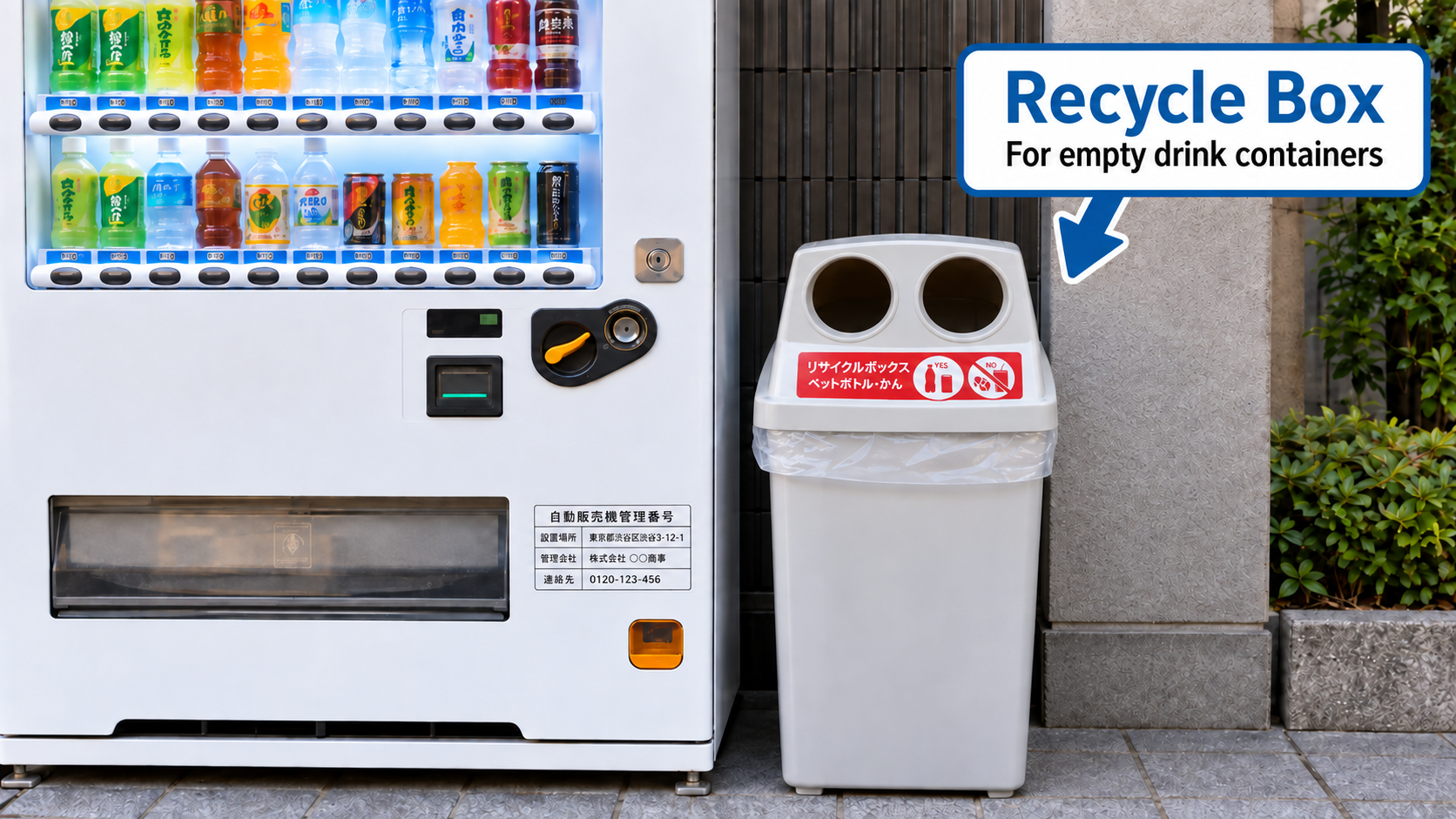
After you finish your drink, you may wonder:
“Where do I put the empty bottle or can?”
You’ll sometimes see a collection box next to a vending machine.
But:
this is not a general trash can.
It is a recycling box for empty drink containers.
- Empty plastic bottles
- Empty cans
- Empty glass bottles
These are the kinds of drink containers the box is meant for.
It is not a place for:
- Bento containers
- Food waste
- Batteries
- Cigarette butts
- Other general trash
Do not put a container in the box if there is still drink left inside.
If there is no recycling box nearby, do not leave the container on the street. Keep it with you until you find somewhere appropriate to dispose of it.
If you can’t find a recycling box or trash can, take the container back to your hotel and dispose of it there.
Please don’t litter on the street.
If your drink or change doesn’t come out, check the sticker on the machine
Occasionally, something goes wrong with a vending machine.
For example:
“I put money in, but the drink didn’t come out.”
“My change didn’t come out.”
“My money got stuck.”
If that happens, check the front of the vending machine.
There should be a sticker with the vending machine operator or contact information.
If your drink or change does not come out, contact the number shown on the sticker.
If possible, check:
- Where the vending machine is located
- The machine number shown on the sticker
- What happened
Having those details ready will make it easier to explain the problem.
That said, if I had a small vending-machine problem while traveling overseas, I would probably value my travel time more than spending it on a phone call in a language I don’t speak.
It’s also useful to know that some vending machines display their address
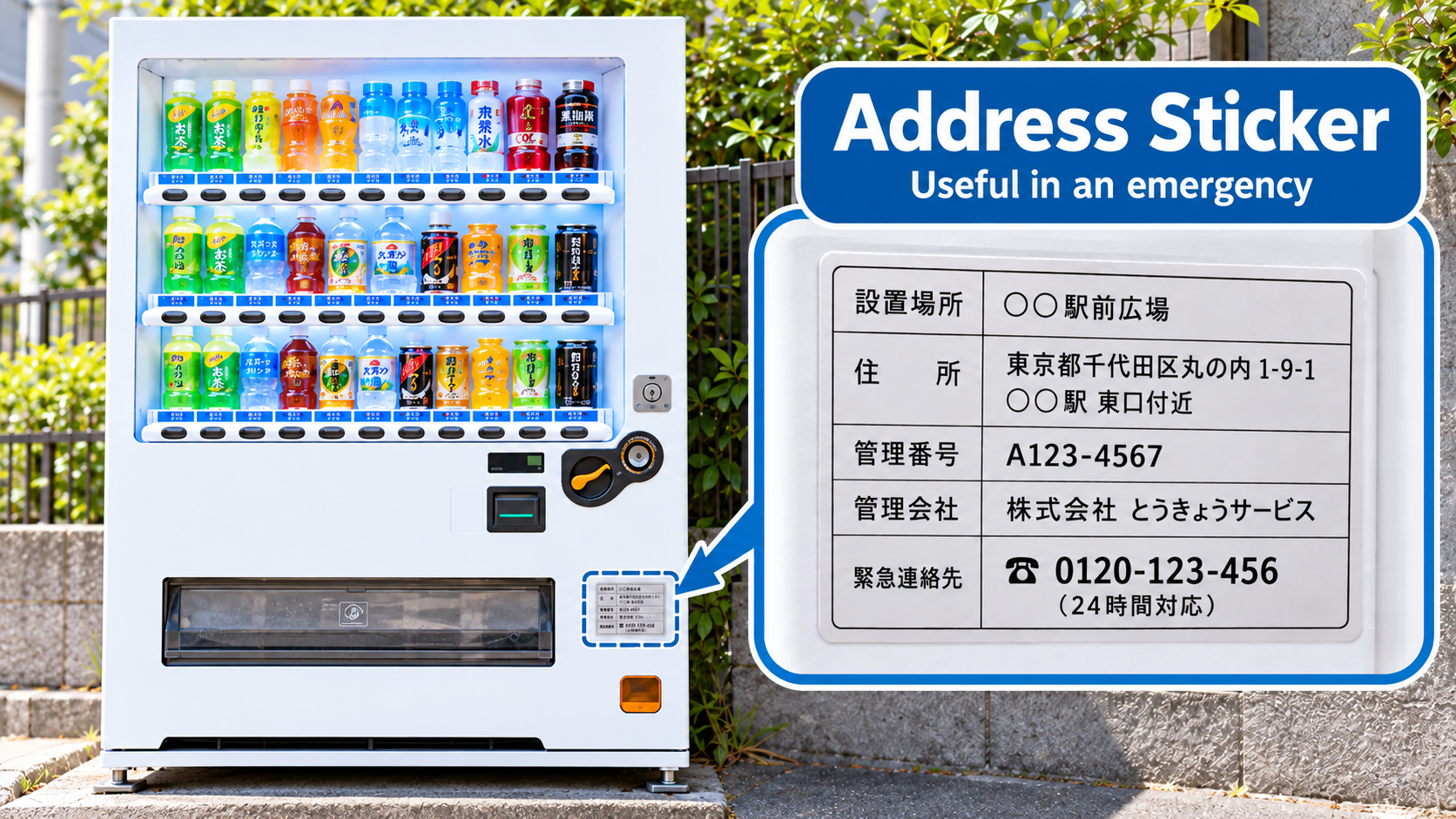
There’s one more label on Japanese drink vending machines that can be useful while traveling.
Some outdoor vending machines have:
a sticker showing the address of the location where the machine is installed.
If you ever find yourself thinking:
“I don’t know exactly where I am.”
or if you need to tell the police on 110 or an ambulance/fire dispatcher on 119 where you are, the address sticker can help you identify your location.
It’s easy to think of a vending machine as nothing more than a place to buy a drink, but this kind of address label can be useful too.
Take a quick look for the address sticker at least once during your trip. It may come in handy in an emergency.
If you use vending machines in Japan, remember these basics
Here’s the short version.
You can use a typical Japanese drink vending machine in this order:
- Choose your drink and check the HOT/COLD label and price
- Check that it is not marked 売切 or 準備中, and whether any 釣り切れ warning affects the change you need
- Check whether you can pay with cash or a supported cashless method
- Select the drink and pay
- Take your drink and any change
- Put the empty container in a recycling box or another appropriate disposal point
If the vending machine accepts Suica or another IC card, you can simply tap to pay.
If it does not, use cash. Keep a ¥1,000 bill or some coins with you.
You do not need Coke ON for a short trip.
Once you’re comfortable with regular drink vending machines, look out for 17 ICE, tax-free vending machines, cup noodle vending machines, and other unusual examples.
By the way, when I visited Poland, I used a vending machine at the bus terminal in Kraków.
Unlike the vending machines I’m used to in Japan, it had a coin slot where you inserted the coin from the front and let it drop down. I still remember being a little surprised by it.
Even something as simple as a vending machine can be different from one country to another. That’s part of what makes travel interesting.
Once you’ve used one, you’ll remember the basic steps right away.
COLD on a hot day, HOT on a cold one.
While you’re exploring Japan, don’t hesitate to use the vending machines along the way.
And in winter, don’t forget the corn soup and oshiruko, woof!
Ready to plan your trip?
Find flights, hotels, transportation, tours, and attraction tickets below.
Flights
Search Flights to Japan
Hotels
Find Hotels in Japan
Airport Transfer
Book an Airport Transfer
Private Car Charter
Travel with a Private Driver
Tours & Experiences
Explore Tours in Japan
Attraction Tickets
Find Tickets in Japan

Explore tours, experiences, and attraction tickets to discover even more ways to enjoy Japan.
Why not take a look and see what’s waiting for you in Japan?