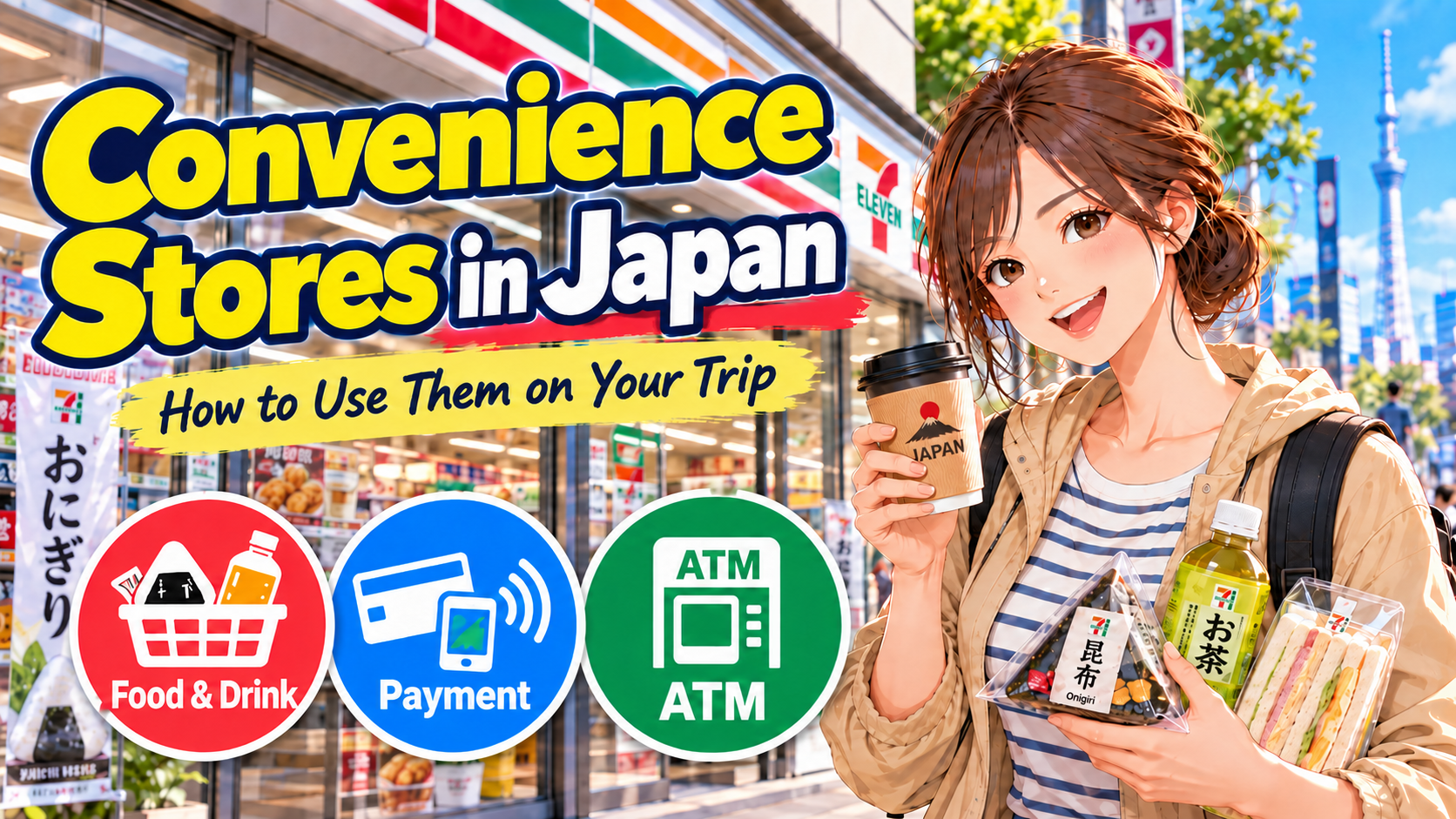
Convenience stores are really useful when you’re traveling in Japan.
They sell much more than drinks and snacks. You can also pick up rice balls, sandwiches, bento, bread, and everyday essentials.
They’re especially handy on your way back to the hotel when you’re thinking:
“I want something else to eat in my room.”
“I’d like to pick up some beer or another alcoholic drink.”
“I want to buy breakfast for tomorrow morning.”
But if it’s your first time using a convenience store in Japan, a few things may not be obvious.
“What do I do at the register?”
“Are shopping bags free?”
“Can I pay by card?”
“Can they heat up the bento I buy?”
These are everyday things for people in Japan, but they can be confusing if you’re visiting for the first time.
Basically, just tell the staff what you need and pay with cash, a credit card, or a transit IC card.
There’s no complicated process.
Here’s how to use a Japanese convenience store in the situations you’re most likely to run into during your trip.
What Can You Buy at a Convenience Store in Japan?
Japanese convenience stores carry a lot of things that are useful while traveling.
For example:
- Rice balls
- Sandwiches
- Bento and noodles
- Bread
- Snacks
- Ice cream
- Water, tea, coffee, and juice
- Beer, Happoshu(発泡酒), canned Chu-hai(チューハイ), and other alcoholic drinks
- Cigarettes and lighters
- Travel essentials such as toothbrushes
The selection varies by store and location, but convenience stores can cover many of the small things you need during a trip.
You may also see hot snacks such as fried chicken displayed near the register.
If you don’t know the name of something, just point to it and say:
“This, please.”(これください)
That’s all you need.
By the way, regular green tea sold at convenience stores in Japan is usually unsweetened. Woof!
What Do You Do at the Convenience Store Register?
This is probably the part that feels most unfamiliar the first time you use a convenience store in Japan.
But there really isn’t much to do.
If You Use a Shopping Basket, Put the Whole Basket on the Counter
If you used a shopping basket at a staffed register, you don’t need to take each item out yourself.
At many supermarkets in the U.S. and Europe, customers put their own items onto the checkout counter or conveyor belt.
At a Japanese convenience store, you can simply place the whole basket on the counter, and the staff will take the items out and scan them.
If you’re only holding one or two items, just place them directly on the counter.
Shopping Bags Cost Extra
Japan introduced charges for plastic shopping bags in July 2020.
So if you need a bag at a convenience store, you’ll normally need to pay for one.
The staff may ask:
“Would you like a bag?”(袋はご利用ですか?)
If you want one, “Yes” is fine.
If you don’t, just say “No.”
A small reusable bag is useful to keep in your travel bag, not only for convenience stores but for other shopping as well.
If You Want Your Bento Heated
When you buy a bento or prepared food, the staff may ask:
“Would you like this heated?”(温めますか?)
If you want it heated, you can simply say:
“Yes.”
or:
“Please heat it up.”(温めてください)
If you need chopsticks, a spoon, or a fork, you can say:
“Chopsticks, please.”(箸をください)
“A spoon, please.”(スプーンをください)
“A fork, please.”(フォークをください)
Chopsticks, spoons, and similar items are often provided for free, although some stores charge for them.
Some products also come with a fork or another utensil.
How Can You Pay at Convenience Stores in Japan?
For normal purchases, payment is usually easy at Japan’s major convenience store chains.
At 7-Eleven, FamilyMart, and Lawson, you can use:
- Cash
- Credit cards
- Transit IC cards such as Suica, PASMO, and ICOCA
Major credit cards such as Visa and Mastercard are also accepted.
If you want to pay with a transit IC card, you can say:
“Suica, please.”(Suicaで)
Depending on the register, you may instead select the payment method yourself on the screen and then tap your card or smartphone on the reader.
Checkout systems vary by store. At some registers, you tell the staff how you want to pay. At others, you choose the payment method yourself on a customer-facing screen.
If a payment screen appears, just select the method you want to use.
Some services, such as stamps, utility bill payments, and certain tickets, have restrictions on which payment methods can be used.
If you’re simply buying food and drinks during your trip, you usually won’t need to worry about that.
7-Eleven Japan Official: Accepted Payment Methods
Lawson Official: Accepted Payment Methods
Pick Up Food and Drinks Before Going Back to Your Hotel
One thing I especially recommend is stopping at a convenience store before you head back to your hotel.
For example, after dinner you may think:
“I’d like one more drink back at the hotel.”
You can pick up beer, Happoshu, canned Chu-hai, and snacks to take back with you.
If you think you might get hungry later, grab a rice ball or sandwich.
And if you’re leaving early the next morning, you can buy breakfast and drinks at the same time.
Stopping at a convenience store before going back to your hotel is an easy way to pick up drinks for the evening and breakfast for the next morning.
Happoshu Is Different from Beer
When you look at the alcohol section in a Japanese convenience store, you may see cans marked:
“ビール”
as well as Happoshu.
They may look very similar, but under Japan’s Liquor Tax Act, Happoshu is classified separately from beer.
You don’t need to learn all the details of Japan’s alcohol classifications while you’re traveling.
But if you specifically want beer, check the label and choose a can marked “ビール.”
That way, you won’t accidentally buy Happoshu thinking it was beer.
On the other hand, if you’re curious about Happoshu, it’s also one of the drinks you’ll see in Japanese supermarkets and convenience stores, so you can give it a try.
You Must Be 20 to Drink or Smoke in Japan
In Japan, drinking alcohol and smoking are prohibited for anyone under 20.
Japan lowered the legal age of adulthood to 18, but the age limit for alcohol and tobacco remains 20.
When you buy alcohol or cigarettes at a convenience store, you may be asked to confirm your age.
If you’re asked to show ID for age verification, you can show your original passport.
If you want to buy cigarettes, look at the tobacco display near the register.
If the products have numbers, you can order by telling the staff the number.
For example:
“Number 25, please.”(25番ください)
This also makes things easier if you don’t know the Japanese name of the brand you want.
Where Can You Eat Food Bought at a Convenience Store?
If you’re taking the food back to your hotel, follow your accommodation’s rules and eat in your room or another permitted area.
If you want to eat inside the convenience store, use a store that has an eat-in area(イートインスペース).
Not every convenience store has one.
If there’s nowhere to eat inside, take your food back to your accommodation, to a park bench, or to another rest area instead of eating it on the spot.
As of September 2026, takeout food and drinks, excluding alcohol, are subject to Japan’s reduced 8% consumption tax rate. If you eat the food in the store, the rate is 10%.
If you plan to use the eat-in area, tell the staff at checkout that you’ll be eating inside.
Avoid Eating While Walking
In Japan, it’s better not to walk around eating in busy areas.
The Japan National Tourism Organization (JNTO) also notes that people in Japan generally don’t eat or drink while moving and recommends stopping somewhere to eat.
If there’s a nearby park bench or rest area, it’s better to stop there.
Avoid Eating on Regular Trains, Subways, Local Buses, and in Taxis
Buying breakfast at a convenience store the night before is useful if you’re leaving your hotel early the next morning.
But avoid eating bento, rice balls, sandwiches, and similar food on regular trains, subways, and local buses.
You should also avoid eating in a taxi.
Food can leave smells, crumbs, or spills inside the vehicle, so wait until you get out before eating.
Eating Is Fine on the Shinkansen and Long-Distance Trains
On the Shinkansen and long-distance trains with tables at your seat, it’s fine to eat on board.
Eating a boxed meal bought at a train station(駅弁)on the train is also a normal part of travel in Japan.
So if you’re thinking:
“I have an early Shinkansen, so I’ll buy breakfast at a convenience store before I get on.”
That’s fine.
Convenience Stores Are Also Useful When You Need Cash
Convenience stores can also be useful when you need to withdraw cash during your trip to Japan.
Seven Bank officially states that you can withdraw Japanese yen at its ATMs using overseas-issued cards from multiple brands, including Visa, Mastercard, American Express, JCB, and Discover.
When using an overseas-issued card at a Seven Bank ATM, the ATM screen is available in 12 languages, including Japanese and English.
However, some cards may not work even if they carry one of the supported brand logos, and fees vary depending on the card.
If you need to withdraw cash, check the brand logo on your card and the information shown on the ATM screen.
Some FamilyMart and Lawson locations also have ATMs.
However, the type of ATM and whether overseas-issued cards are supported vary by location.
Not Every Convenience Store Is Open 24 Hours
Many convenience stores in Japan are open 24 hours.
However:
Not every convenience store is open 24 hours.
Stores inside train stations, airports, hotels, office buildings, and shopping facilities may follow the operating hours of the building they’re located in.
Lawson’s official information for international visitors, for example, includes stores that are open 24 hours as well as stores with hours such as:
7:00 a.m.–11:00 p.m.
9:00 a.m.–9:00 p.m.
If you’re planning to use a convenience store late at night or early in the morning, check the opening hours of the store near you.
How to Make the Most of Convenience Stores During Your Trip
A convenience store isn’t so much a place for major shopping as it is a place to quickly pick up something you need while you’re traveling.
Grab breakfast or a drink.
Pick up a drink or a late-night snack before heading back to your hotel.
Use an ATM when you need cash.
That’s really all you need to remember.
I once arrived in Kraków, Poland, late at night.
There was a convenience store near my hotel, so I thought, “I can just go later,” and checked into the hotel first.
But when I went out to the convenience store, it had already closed.
It was a little disappointing.

Ready to plan your trip?
Find flights, hotels, transportation, tours, and attraction tickets below.
Flights
Search Flights to Japan
Hotels
Find Hotels in Japan
Airport Transfer
Book an Airport Transfer
Private Car Charter
Travel with a Private Driver
Tours & Experiences
Explore Tours in Japan
Attraction Tickets
Find Tickets in Japan

Explore tours, experiences, and attraction tickets to discover even more ways to enjoy Japan.
Why not take a look and see what’s waiting for you in Japan?