
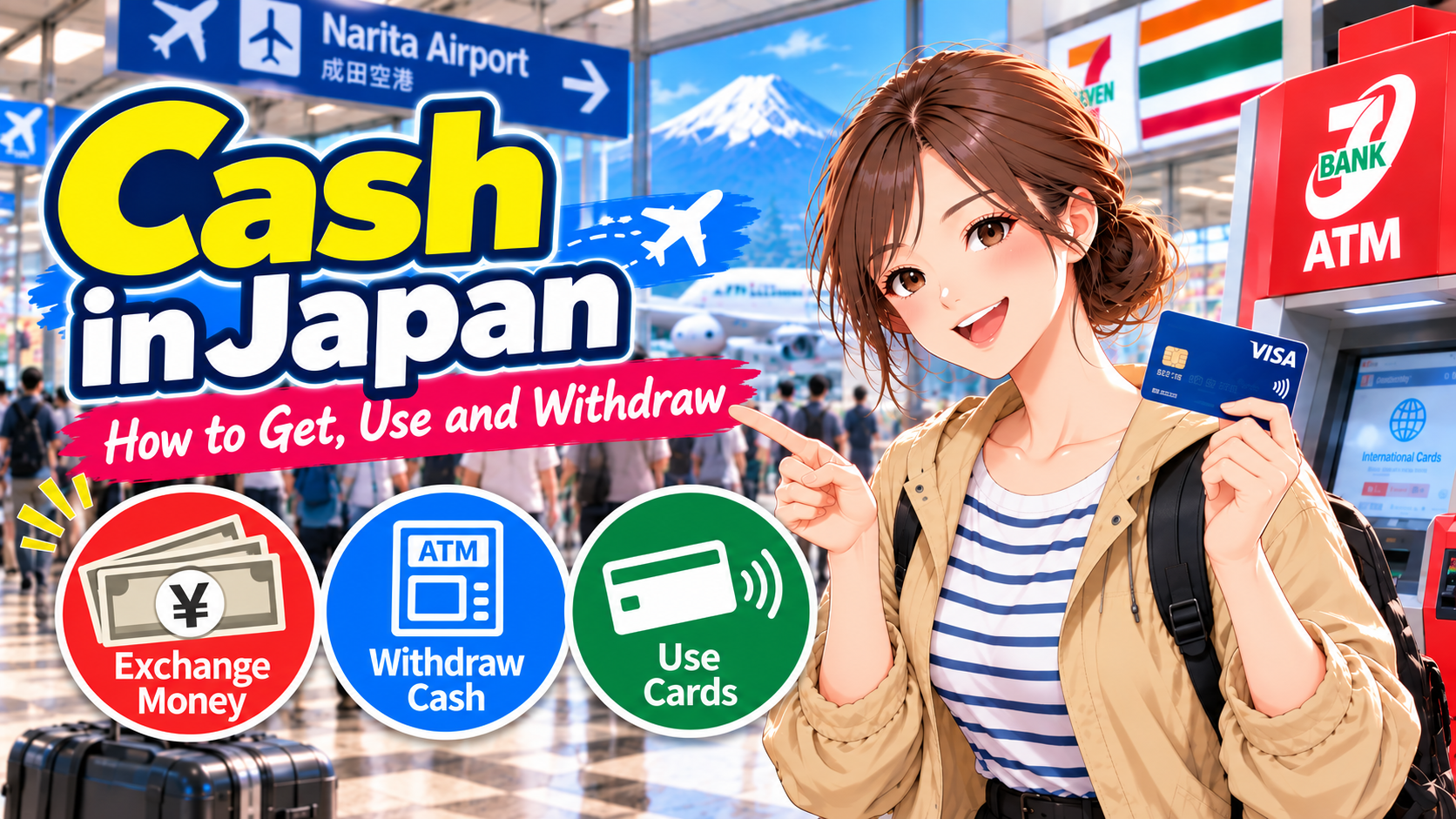
You don’t need to carry all the money you expect to spend in Japan as cash.
Credit cards, contactless payments, and other cashless options are now widely accepted in Japan.
That said, there are still places where you’ll need cash.
“How much cash should I bring to Japan?”
“Should I get Japanese yen before I leave, or exchange money at the airport in Japan?”
“If I run low on cash, can I withdraw yen from an ATM using my card from home?”
These are common questions.
If you’re mainly visiting major cities and plan to use credit cards, Japan Travel Decoded recommends starting with around ¥10,000–¥20,000 in cash per person when you arrive, then withdrawing more from an ATM if you need it.
This does not mean you need ¥10,000–¥20,000 per person per day. It’s simply a guideline for how much cash to have on hand when you first arrive in Japan.
¥10,000 is on the lower end and works best if you plan to use credit cards for most purchases and can withdraw more cash from an ATM when needed.
If you’d rather start with a little more breathing room, around ¥20,000 is a good option.
The amount you need will also depend on your itinerary, such as whether you’re traveling to rural areas or plan to use many cash-only shops.
In this guide, I’ll explain how much cash you may want to carry, where to get Japanese yen, and how to withdraw yen from ATMs in Japan.
How Much Cash You Need in Japan Doesn’t Depend on Trip Length Alone
Even on a one-week trip, you may not use much cash if you pay for hotels and most of your shopping by credit card.
On the other hand, you’ll use more cash if you visit rural areas or plan to use cash-only shops and facilities.
So instead of deciding how much cash to bring based only on the length of your trip, think about:
- How often you plan to use a credit card
- Whether you’re staying mainly in major cities or also visiting rural areas
- Whether you plan to visit cash-only shops or facilities
- Whether you can withdraw more cash from a Japanese ATM if you need it
These factors will give you a much better idea of how much cash to carry.
When Do You Need Cash in Japan?
Cashless payments have become much more common in Japan.
Many major hotels, department stores, large shopping centers, and restaurants in cities accept foreign-issued credit cards.
However, you may still need cash at places such as:
- Small cash-only shops and facilities
- Some supermarkets and drugstores
- Some shops and accommodations in rural or remote areas
- Ticket machines and other equipment that only accept cash
- When topping up a physical transportation IC card with cash
The Japan National Tourism Organization (JNTO) also advises travelers to check payment methods in advance and carry cash, especially when visiting rural or remote areas.
Before heading out to a rural area, check how much cash you have with you.

You can get around Tokyo or Osaka using cards for many things, but the situation can change once you head into rural areas.
It’s also a good idea to check how your hotel and any facilities you plan to visit accept payment before you go.
Three Ways to Get Japanese Yen
There are three main ways to get Japanese yen:
- Get Japanese yen before you leave
- Exchange money at airports or currency exchange counters near major stations in Japan
- Withdraw Japanese yen from an ATM in Japan
1. Get Japanese Yen Before You Leave
Depending on your country and financial institution, you may be able to get Japanese yen from a bank or foreign currency exchange service before your trip.
However, even if a financial institution handles Japanese yen, that doesn’t mean every branch keeps yen banknotes in stock.
You may need to order them in advance.
If you want to get yen before your trip,
check whether your bank or foreign currency exchange service can exchange your money into Japanese yen.
The advantage is simple: you’ll already have cash ready to use as soon as you arrive in Japan.
Major airports in Japan have currency exchange counters, but there may be lines when several flights arrive around the same time.
After a long flight, you may already have gone through:
Immigration
↓
Baggage claim
↓
Customs
↓
Then currency exchange
If you’d rather not add another stop after all that, you can get just enough yen for your first few expenses before you leave.
Exchange rates and fees vary depending on the bank or currency exchange service you use.
When I traveled to Egypt, the currency exchange counter was extremely crowded.
The guide for a group tour kept letting tour members cut in line.
I had already arranged for a car to pick me up, so I eventually gave up on exchanging money.
After that, I had trouble getting local currency for a while.
At the time, I even needed local currency to use the restroom, so I realized that arriving without any cash can be surprisingly inconvenient.
2. Exchange Money at Airports or Currency Exchange Counters Near Major Stations
If you don’t get Japanese yen before your trip, you can exchange money after you arrive in Japan.
Major airports in Japan have currency exchange counters in their arrival areas.
Outside airports, you can also exchange money at:
- Currency exchange shops at or near major stations
- Banks that offer foreign currency exchange
- Some hotels
However, the foreign currencies accepted vary by exchange location.
Not every bank branch or hotel offers foreign currency exchange.
Many Japanese bank branches also close at around 3:00 p.m., so if you plan to exchange money at a bank, check its opening hours.

Some currency exchange shops and banks may ask you to show identification.
If you’re visiting Japan from overseas, it’s a good idea to bring your passport when exchanging money. Woof!
3. Withdraw Yen from a Japanese ATM with a Foreign-Issued Card
Some ATMs in Japan allow you to withdraw Japanese yen using cards issued by financial institutions overseas.
Two common ATM options for international travelers are:
- Seven Bank ATMs
- Japan Post Bank ATMs
However, simply having a credit card does not necessarily mean you can withdraw cash from an ATM.
Some cards do not allow overseas cash advances, while others may not have a cash advance limit set.
If you plan to withdraw Japanese yen with a credit card, check with your card issuer before your trip to make sure overseas ATM cash advances are enabled and to find out how much you can withdraw.
Seven Bank ATMs Are Easy to Find While Traveling in Japan
Seven Bank has more than 28,000 ATMs across Japan, many of them inside 7-Eleven stores.
You can also find them at airports, train stations, shopping centers, and other locations.
Foreign-issued cards from networks including the following are supported:
- Visa / PLUS
- Mastercard / Maestro / Cirrus
- American Express
- JCB
- Discover
- Diners Club
- UnionPay
However, even if your card has one of these logos, it may still not work.
For foreign-issued cards, the maximum withdrawal per transaction at a Seven Bank ATM is ¥100,000.
For transactions using the magnetic stripe, the limit is ¥30,000.
Seven Bank ATMs are generally available 365 days a year, but service hours for foreign-issued cards vary by card network.
Visa / PLUS and Mastercard / Maestro / Cirrus are generally available 24 hours a day.
Other card networks may have short periods late at night when the service is unavailable.
ATM fees for foreign-issued cards at Seven Bank vary depending on the card network.
Your bank or card issuer may also charge a separate overseas ATM fee.
The ATM fee is shown on the ATM screen.
How to Withdraw Japanese Yen at a Seven Bank ATM
Seven Bank ATMs support 12 languages, including English.
The basic process is:
- Insert your card into the ATM
- Select English or another language
- Select “Withdrawal”
- Select the account you want to use
- Enter your PIN
- Select the amount of Japanese yen you want to withdraw
- If you are asked to choose a transaction currency, select the currency you want to use
- Take your cash, card, and receipt
If you plan to use an ATM, make sure you know your card’s PIN before your trip.
You Can Also Use Foreign-Issued Cards at Japan Post Bank ATMs
Japan Post Bank ATMs also allow withdrawals in Japanese yen using supported cards issued by overseas financial institutions.
Supported networks include:
- Visa / PLUS
- Mastercard / Maestro / Cirrus
- JCB
- UnionPay
- Discover
The withdrawal limit for foreign-issued cards at Japan Post Bank ATMs is ¥50,000 per transaction.
For some foreign-issued cards, an ATM fee of ¥220 per transaction applies.
Your card issuer may charge additional fees as well.
At ATMs located in post offices and similar locations, foreign-issued cards can generally be used from 7:00 a.m. to 11:00 p.m. Monday through Saturday, excluding public holidays.
On Sundays, public holidays, December 31, and January 1–3, they are generally available from 7:00 a.m. to 9:00 p.m.
Compact Japan Post Bank ATMs located in FamilyMart convenience stores and similar locations are generally available from 12:05 a.m. to 11:55 p.m.
On the third Monday of each month, service starts at 7:00 a.m.
Actual service hours vary by ATM location, so if you plan to withdraw cash early in the morning or late at night, check the operating hours of the ATM you plan to use.
What If the ATM Asks You to Choose Between Your Home Currency and Japanese Yen?
When using some foreign-issued Visa or Mastercard cards at Seven Bank ATMs, you may be asked to choose between:
“Pay in your home currency”
and
“Pay in Japanese yen”
This is called DCC (Dynamic Currency Conversion).
It can be a little confusing.
If You Choose Your Home Currency
For example, if you have a U.S. card, the ATM may show an amount in U.S. dollars.
The amount in your home currency is fixed at the time of the ATM transaction.
In this case, the exchange rate offered through DCC is used.
The DCC exchange rate may include additional fees or a markup.
If You Choose Japanese Yen
If you choose Japanese Yen (JPY), the ATM processes the transaction in yen.
Your bank or card issuer then converts the amount into your home currency.
Depending on your card issuer, foreign transaction fees or currency conversion fees may apply.
In other words,
choosing Japanese yen does not mean there are no fees.
If you can’t confidently compare the DCC rate on the spot, Japan Travel Decoded generally recommends choosing “Japanese Yen (JPY)” and letting your bank or card issuer handle the currency conversion.
Visa also explains that converting the transaction into your home currency may include a markup, and advises choosing the local currency if you want to avoid that DCC markup.
However, the final amount you pay will also depend on your card issuer’s exchange rate and overseas transaction fees.
Check ATM Fees
When you withdraw Japanese yen with a foreign-issued card, the amount of cash you receive may not be the only cost.
Fees to look out for include:
- Fees charged by the ATM operator in Japan
- Overseas ATM fees charged by your bank or card issuer
- Currency conversion fees
- Cash advance fees or other costs if you use a credit card
Seven Bank also states that fees for foreign-issued cards vary depending on the card network.
If you’re concerned about fees, check your card’s overseas ATM fee, currency conversion fee, and daily withdrawal limit before traveling to Japan.
When an ATM operator charges a fee, it is generally shown on the ATM screen before you confirm the transaction.
However, additional fees charged separately by your bank or card issuer may not appear on the ATM screen.
Don’t Rely on Just One Card During Your Trip
A card that works normally at home may not always work at every shop or ATM in Japan.
We recommend having more than one card available for payments and cash withdrawals.
For example:
- Bring both a credit card and a debit card
- If you bring multiple credit cards, use cards from different issuers if possible
- If possible, choose different card networks as well, such as Visa and Mastercard
Even cards on the same international network may be subject to different restrictions depending on the card issuer.
So if you bring multiple cards, using different issuers and, if possible, different international card networks gives you another option if one card does not work.
It’s also a good idea not to keep all of your cards in the same wallet. Keeping them in separate places gives you a backup if your wallet is lost or stolen.
If You Carry More Than ¥1 Million in Cash or Other Means of Payment, You Must Declare It to Customs
Most travelers carrying a normal amount of cash for a trip will not need to worry about this procedure.
However, there are rules if you bring a very large amount of cash or other means of payment into or out of Japan.
If the total value of cash and other means of payment you are carrying exceeds the equivalent of ¥1,000,000 when entering or leaving Japan, you must declare it to Japan Customs.
This includes:
- Japanese yen and foreign currency in cash
- Checks and traveler’s checks
- Promissory notes
- Securities
This does not mean:
“You can only bring up to ¥1,000,000 into Japan.”
The rule is that you must make a customs declaration if the total exceeds the equivalent of ¥1,000,000.
Check Your Card Issuer’s Overseas Use Settings Before You Travel
Even if you normally use your credit card without any problems, suddenly using it overseas may trigger fraud detection.
A transaction may be declined, or your card may be temporarily restricted.
Before traveling to Japan, use your card issuer’s app or official website to check:
- Whether your card can be used in Japan
- Whether you need to submit a travel notice or register your destination
- Whether any overseas-use restrictions are enabled
- Whether your registered phone number and email address are up to date
Some card issuers recommend registering your travel destination, while others no longer require travel notifications at all.
Check what your own card issuer requires for overseas travel.
It’s also a good idea to make sure you can receive SMS messages, emails, or app notifications from your card issuer while traveling, in case they contact you about possible fraud.
Prepare These Things Before Your Trip to Japan
Here’s a final checklist before you leave:
- Check your card issuer’s overseas-use settings and whether a travel notice is required
- If you plan to withdraw cash with a credit card, check whether overseas cash advances are available and what your cash advance limit is
- Know where you can exchange money during your trip in case you cannot withdraw cash from an ATM
- If you don’t want to wait at a currency exchange counter after arriving in Japan, prepare a small amount of Japanese yen in advance
Doing this will greatly reduce the chances of arriving in Japan and suddenly wondering:
“I don’t have any cash.”
“This card won’t work at the ATM.”
“Where can I get Japanese yen?”
Want to know more about transportation IC cards, which can make getting around Japan much easier? Check out the guide below. Woof!

Ready to plan your trip?
Find flights, hotels, transportation, tours, and attraction tickets below.
Flights
Search Flights to Japan
Hotels
Find Hotels in Japan
Airport Transfer
Book an Airport Transfer
Private Car Charter
Travel with a Private Driver
Tours & Experiences
Explore Tours in Japan
Attraction Tickets
Find Tickets in Japan

Explore tours, experiences, and attraction tickets to discover even more ways to enjoy Japan.
Why not take a look and see what’s waiting for you in Japan?