

When taking a taxi in Japan for the first time, you may wonder:
“How do I get a taxi?”
“Will the driver speak English?”
“Can I pay by card?”
“Do I open the door myself?”
“Do I need to tip?”
There are quite a few things that may not be obvious at first.
But taking a taxi in Japan is not that difficult.
If it’s your first time, we recommend using a taxi stand at a station or airport, or a ride-hailing app such as GO or Uber if it is available in the area.
You can also hail an available taxi on the street.
This guide explains how to get a taxi in Japan, how to ride one, fares, payment methods, luggage, traveling with children, and what to do if you leave something behind.
3 Ways to Get a Taxi in Japan
Each method works best in different situations.
At stations and airports, use a taxi stand. On the street, hail an available taxi. If you cannot find one nearby, try a ride-hailing app.
1. Use a Taxi Stand at a Station or Airport
If it is your first time taking a taxi in Japan, the easiest option is usually a taxi stand.
Major stations and airports often have designated taxi stands.
If taxis and passengers are lined up, join the passenger line and wait for your turn.
If you are leaving from a hotel, the front desk may also be able to call a taxi for you.
This is especially convenient if you have a large suitcase or have not set up a ride-hailing app yet.
2. Hail a Taxi Showing “空車” on the Street

You can also hail a taxi that is driving along the street.
Taxis have a sign near the front showing whether they are available to take passengers.
A red sign means the taxi is available, while a green sign means it is occupied.
When you see a taxi displaying “空車” (available), raise your hand where the driver can see you.
If there is a taxi stand near a station, it is usually more reliable to use the stand than to search for a taxi on the road.
3. Use a Ride-Hailing App Such as GO or Uber
You can also call a taxi in Japan using your smartphone.
The Japan National Tourism Organization (JNTO) lists the following ride-hailing apps that can be used in English:
- GO
- Uber
- DiDi
- S.RIDE
One major advantage of ride-hailing apps is that you can set your pickup point and destination on your phone.
Even if you do not speak Japanese, this reduces the need to explain your hotel name or address to the driver verbally.
However, there is one important point to remember.
Ride-hailing apps cannot be used everywhere in Japan.
GO and Uber Taxi currently operate in all 47 prefectures, but that does not mean they are available in every city, town, or area within those prefectures.
Service areas are limited, and even within a supported area, you may not be able to get a ride if there are no nearby vehicles at that time.
When traveling outside major cities, do not assume:
“This prefecture is supported, so I’ll be fine.”
Instead, check in the app whether rides are actually available where you are staying.

In rural areas, you may be able to get a taxi from the station on the way there but struggle to find one at the sightseeing spot when you want to return.
It is a good idea to work out your return transportation in advance.
If You Use GO With a Non-Japanese Phone Number, Check the Payment Method
GO supports internationally issued credit cards and Apple Pay.
However, for accounts registered from June 2025 onward, only users with a Japanese phone number can select in-car payment.
Travelers who register with a phone number from outside Japan need to set up and use GO Pay.
Currently, in applicable areas, choosing in-car payment when requesting a ride through GO incurs a ¥100 handling fee. This handling fee does not apply when you choose GO Pay.
If you plan to use GO, it is better to set it up before your trip or at your hotel rather than waiting until you urgently need a taxi.
How to Take a Taxi in Japan: From Getting In to Getting Out
Here is the basic process:
- Get a taxi
- Wait for the door to open and get in
- Tell the driver your destination
- Fasten your seat belt
- Pay the fare when you arrive
- Take your receipt and get out
You Usually Do Not Need to Open the Rear Door Yourself
One thing that often surprises international travelers is the taxi door.
In many Japanese taxis, the driver operates the rear passenger door and opens and closes it for you.
When the taxi stops, wait for the door to open before getting in.
The same applies when you get out.
Do not open or close an automatically operated door yourself.
Show Your Destination in Japanese
Even in major cities such as Tokyo and Osaka, not every taxi driver speaks English.
We recommend having your destination ready in Japanese.
For example:
- The hotel or facility name in Japanese
- The address in Japanese
- A map such as Google Maps
Keep these ready to show on your smartphone.
It is usually easier to show the Japanese name and address on your screen than to try to read the address aloud in English.
If you use a ride-hailing app, you can enter the destination in advance, which reduces the need for this conversation.
You do not need to worry about how to explain your destination in English.
Just show the driver the Japanese name and address on your smartphone.
Wear Your Seat Belt in the Back Seat Too
In Japan, seat belts are required in all seats, including the rear seats.
When you get into a taxi, fasten your seat belt even if you are sitting in the back.
How Are Taxi Fares Calculated in Japan?
Regular taxi fares in Japan are generally calculated using a meter.
Fares are not the same nationwide.
The starting fare and the amount added for additional distance vary by region.
Japanese taxi fares can also take into account the amount of time the vehicle is traveling below a certain speed, not just the distance traveled.
This means traffic congestion can make the fare higher even when traveling the same distance.
In Tokyo’s 23 Wards, Fares Start at ¥500 for the First 1 km
As of October 2026, the standard taxi fare in Tokyo’s 23 wards, Musashino City, and Mitaka City is:
- Up to 1.0 km: ¥500
- After that: ¥100 for every 232 m
- At speeds of 10 km/h or less: ¥100 for every 1 minute 25 seconds
- 10:00 p.m. to 5:00 a.m.: 20% surcharge
These are examples for Tokyo’s 23 wards and the surrounding areas listed above.
These fares do not apply everywhere in Japan.
Calling a Taxi by App or Phone May Add Pickup Fees
A taxi you hail on the street and a taxi you call to your location may not cost exactly the same.
Depending on the taxi company, a pickup fee may be added when you request a taxi by app or phone.
Reservations and certain app services may also have additional service fees.
Late-Night Taxi Fares Are Higher
In Tokyo’s 23 wards and the areas mentioned above, fares are 20% higher from 10:00 p.m. to 5:00 a.m.
Taxis are still an option after the trains stop running, but remember that the fare will be higher than during the daytime.
Fixed-Fare Taxis May Be Available at Airports
At airports such as Haneda and Narita, fixed taxi fares are available between the airport and certain designated areas.
If you plan to take a taxi from the airport, check the airport’s official taxi page, the local taxi association, or the taxi company’s official website to see whether your destination qualifies for a fixed fare.
For example, fixed fares between Haneda Airport and parts of Tokyo can be checked on the Tokyo Hire-Taxi Association website. Fixed fares from Narita Airport to areas in Tokyo can be checked on the official Narita Airport website.
Conditions vary depending on the airport, direction of travel, and taxi company, including:
- Eligible areas
- Whether advance reservations are required
- Late-night and early-morning surcharges
- Expressway tolls
Do not assume that every airport taxi uses a fixed fare. Check your destination and the fare before you ride.
Haneda Airport Fixed Fares | Tokyo Hire-Taxi Association
Taxi | Narita International Airport
How to Pay for a Taxi in Japan: Cash, Cards, and Suica
Taxis in Japan may accept several payment methods, including:
- Cash
- Credit cards
- Transportation IC cards such as Suica and PASMO
- QR code payments
- In-app payments
Not every taxi accepts the same payment methods.
Credit cards are widely accepted in taxis in major cities, while some taxis in rural areas may still accept cash only.
If you want to pay by card or transportation IC card, check the payment logos displayed inside the taxi or on the door.
We recommend carrying a small amount of Japanese yen as well instead of relying entirely on cards.

Some taxis need a little time to get the card or transportation IC card payment terminal ready.
If you want to pay by card or Suica, tell the driver a little before you arrive instead of waiting until the last moment. Woof!
In-App Payment Makes Paying at Your Destination Easier
If you request a taxi using an app with a registered payment method, such as GO Pay, you can pay through the app.
With GO Pay, you do not need to hand the driver cash or a card after reaching your destination.
For international travelers, this also reduces the amount of conversation needed when paying.
You Do Not Need to Tip
You do not need to tip taxi drivers in Japan.
Just pay the fare shown.
Some Japanese passengers paying in cash may say “keep the change” when the amount is small. However, this does not mean that Japan has a tipping culture.
Do You Need to Worry About Taxi Scams in Japan?
As an international traveler, you may wonder:
“Could I be overcharged?”
“Could the driver take me on an unnecessarily long route?”
Licensed taxi companies in Japan cannot simply set their fares however they like.
Taxi fares are subject to approval by Japan’s Minister of Land, Infrastructure, Transport and Tourism, and the fare for a regular metered ride is shown on the meter inside the vehicle.
In other words, licensed taxi drivers do not simply decide how much to charge after seeing that you are a foreign traveler.
However, if the fare is higher than you expected, that does not automatically mean you were overcharged.
A higher fare may be caused by:
- Spending a long time moving slowly in traffic
- The late-night or early-morning surcharge from 10:00 p.m. to 5:00 a.m.
- Pickup fees or app service fees
- A detour caused by road conditions
Japan’s Ministry of Land, Infrastructure, Transport and Tourism has also introduced an upfront fare system through ride-hailing apps to reduce concerns about meter fares increasing because of traffic or detours.
If you are concerned about the fare, using a service that lets you check the price before getting in is one option.
Be More Careful About Illegal “Shiro-taku” Rides
One thing international travelers should pay particular attention to is “shiro-taku,” an illegal paid transportation service using a private vehicle without the required authorization.
Japan’s Ministry of Land, Infrastructure, Transport and Tourism continues to warn international visitors not to use illegal shiro-taku services around airports, tourist areas, and other locations.
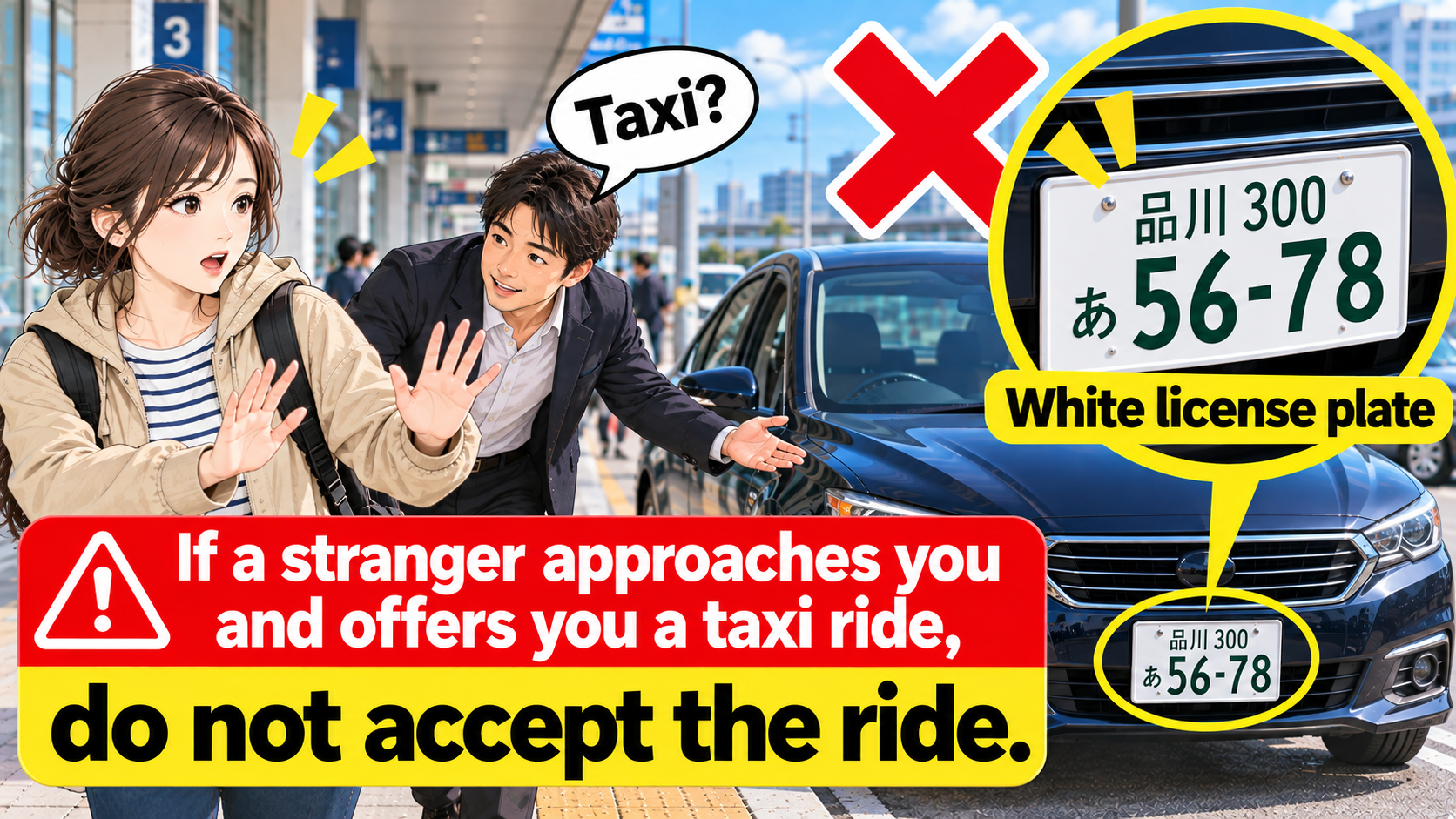
If a stranger approaches you at an airport or tourist area and says something like “Taxi?” or offers to take you to your hotel, do not simply follow them and get into their private car.
If you need a taxi, we recommend:
- Using an official taxi stand at an airport or station
- Asking your hotel to call a taxi
- Booking through a ride-hailing app you are using, such as GO or Uber
How Can You Identify a Shiro-taku?
Regular licensed taxis in Japan generally have green license plates.
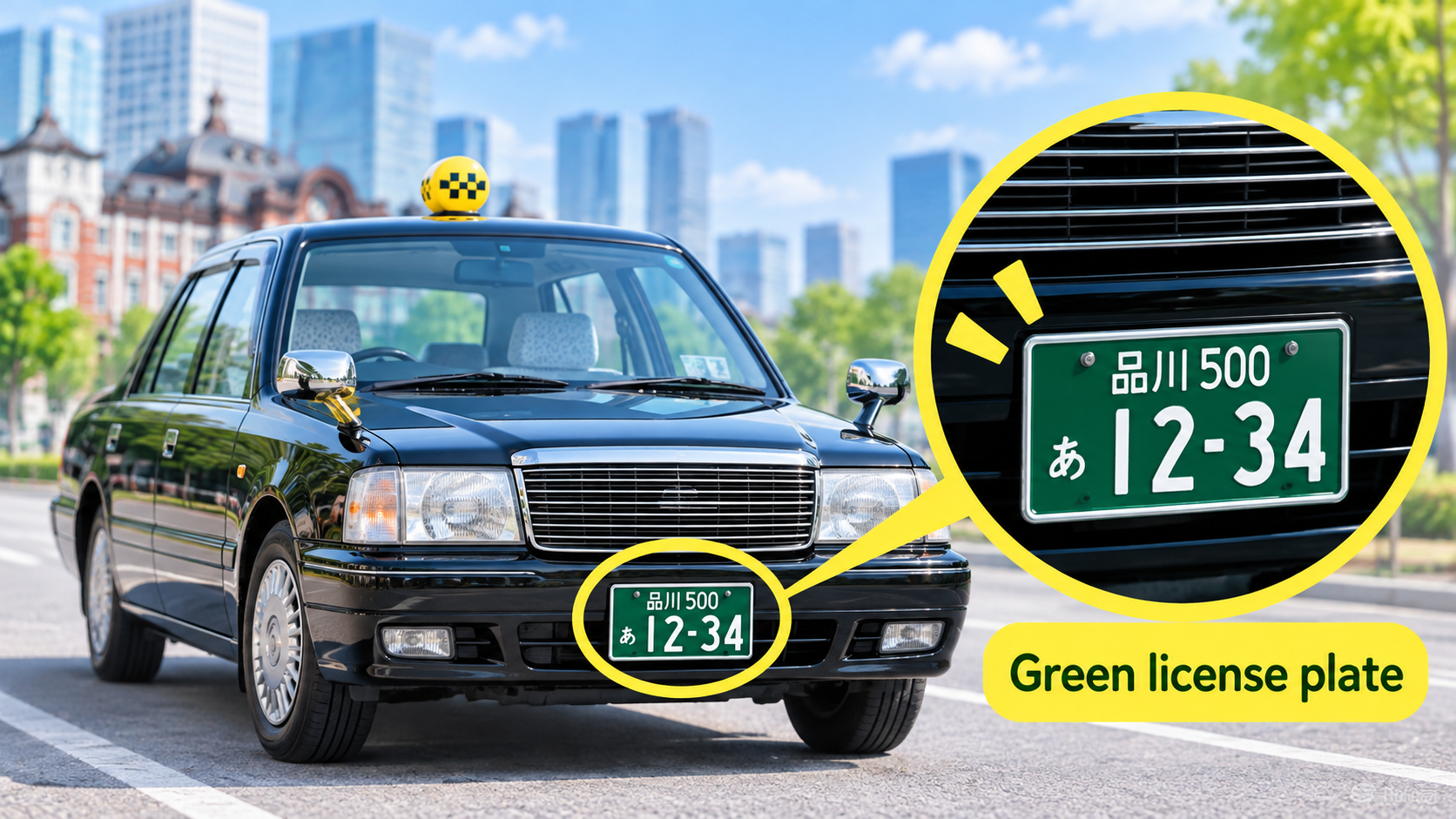
A private vehicle with a white license plate that illegally carries passengers for payment is commonly referred to as a “shiro-taku.”
The “shiro” (white) in “shiro-taku” refers to the vehicle’s white license plate, not the color of the car.
However, a white license plate does not automatically mean the vehicle is operating illegally.
Japan also has an official rideshare system in which private vehicles with white license plates can carry paying passengers under the management of taxi companies.
Authorized vehicles operating under Japan’s rideshare system display information showing that they are being used for rideshare operations, along with the name of the company managing them.
For travelers, the easiest way to tell is not simply by the color of the license plate, but by looking at how the ride was arranged.
A taxi taken from an official taxi stand at an airport or station, arranged by your hotel, or booked through a service such as GO or Uber is easier to verify.
If a stranger approaches you and offers you a taxi ride, do not accept the ride.
As a general rule, licensed taxi drivers in Japan do not approach people on the street to solicit passengers.
This is different from being directed to a licensed taxi by staff at an official airport taxi stand or by hotel staff.
Illegal “shiro-taku” rides typically use private vehicles with white license plates.
Can You Take Large Suitcases in a Taxi?
Suitcases can be placed in the trunk or other luggage space of a taxi.
Of course, there are limits to how many passengers and pieces of luggage a vehicle can carry.
If several people are traveling with several large suitcases, do not assume that everything will fit into one regular taxi.
Book a larger taxi, a van, or an airport transfer vehicle instead.
In some areas, GO also allows you to request certain vehicle types, such as JPN TAXI.
Taking a Taxi With Babies or Children
In Japan, children under the age of 6 are generally required to use a child safety seat when traveling in a private car.
However, buses and taxis are legally exempt from the child-seat requirement.
For that reason, regular taxis do not carry child seats as standard equipment.
GO also does not offer an option to specifically request a taxi with a child seat through its regular dispatch service.
If you want to use a child seat, your options include:
- Bring your own child seat
- Contact a taxi company in advance and ask what they can provide
- Look for a specialized service such as a kids taxi
Using Taxis After the Last Train or in Rural Areas
Taxis can still be an option after trains and buses have stopped running.
However, the situation can be very different in major cities and rural areas.
At rural sightseeing destinations,
just because you found a taxi at the station on the way there does not mean you will easily find another one when you want to return.
You may be outside the service area of a ride-hailing app, or there may simply be no nearby vehicles even within a supported area.
For rural sightseeing spots, early-morning airport trips, or journeys where you must arrive at a specific time, it is more reliable to ask your accommodation or a taxi company to arrange a taxi in advance.
What If You Leave Something in a Taxi? Keep Your Receipt
Before getting out of the taxi, check the seat for things such as:
- Your smartphone
- Your wallet
- Your passport
- Your bag
- Anything you bought while shopping
We also recommend keeping your taxi receipt instead of throwing it away immediately.
The receipt can help you identify and contact the taxi company you used.
If you booked through a ride-hailing app, you may also be able to check your ride details in the app.
Keep the receipt at least until you have finished traveling for the day.
If you realize you left something behind, it will make it easier to identify which taxi you took.
6 Things to Remember When Taking a Taxi in Japan
If it is your first time taking a taxi in Japan, remember these six points:
- Use taxi stands at stations and airports
- Check whether ride-hailing apps are available in your area
- Show the driver the Japanese name and address of your destination on your smartphone
- Carry a small amount of cash even if you plan to pay by card
- Do not accept unsolicited taxi rides offered by strangers
- Take your receipt when you get out
Taxis in Japan are more expensive than trains and subways.
However, they can be very useful when you have large luggage, when public transportation has stopped running, or when you need to reach somewhere far from a station.
Check whether it will be easy to find a taxi where you are going or whether a ride-hailing app works there, and choose the option that fits your situation.
More Guides to Getting Around Japan





Ready to plan your trip?
Find flights, hotels, transportation, tours, and attraction tickets below.
Flights
Search Flights to Japan
Hotels
Find Hotels in Japan
Airport Transfer
Book an Airport Transfer
Private Car Charter
Travel with a Private Driver
Tours & Experiences
Explore Tours in Japan
Attraction Tickets
Find Tickets in Japan

Explore tours, experiences, and attraction tickets to discover even more ways to enjoy Japan.
Why not take a look and see what’s waiting for you in Japan?