
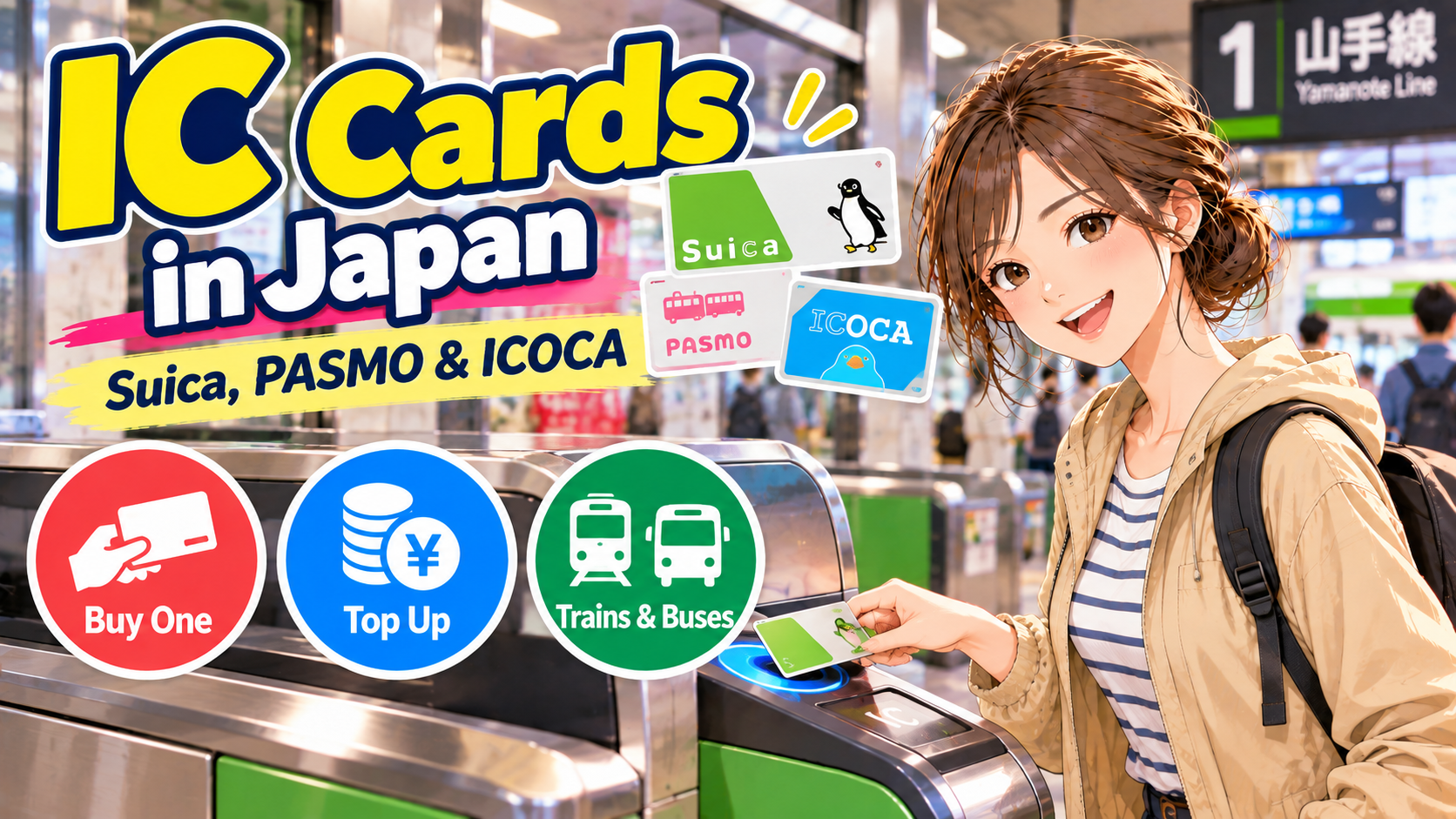
If you buy a paper ticket every time you take a train in Japan, you first need to check the fare to your destination, find a ticket machine, and buy the correct ticket.
With a transportation IC card such as Suica, PASMO, or ICOCA, you can skip most of that hassle.
Just tap your card at the ticket gate. The fare for your journey is calculated automatically and deducted from your card balance.
You can also use these cards to pay for rides in taxis that accept IC cards, as well as at convenience stores, restaurants, vending machines, coin lockers, and more.
If you plan to use trains, subways, and buses several times during your trip to Japan, I recommend having one transportation IC card.
Suica, PASMO, and ICOCA have different names, but you can use them outside the region where they were issued as long as you are traveling within areas that support nationwide IC card interoperability.
For example, you can buy a Suica in Tokyo and use it in Osaka.
So even if you are visiting several cities in Japan, you do not need to buy a different IC card for each region.
However, in Tokyo, you will come across several similar cards:
- Welcome Suica
- TOURIST PASMO
- Regular Suica
- Regular PASMO
That can leave you wondering:
“Which one should I actually buy?”
Let’s start by sorting out the differences.
In Tokyo, First Choose Between ① a Card for Travelers and ② a Regular Card
If you compare all four IC cards separately, things can get confusing.
It is easier to start by dividing them into two groups.
① Cards for Travelers
- Welcome Suica (top-ups after purchase are generally cash only)
- TOURIST PASMO (top-ups after purchase are generally cash only)
*At Haneda Airport, the TOURIST PASMO card itself can be purchased by credit card at designated ticket machines.
These two cards are designed for international visitors staying in Japan for a short period.
They have several things in common:
- No ¥500 deposit
- Valid for 28 days from the date of purchase
- You can take the card home with you when your trip is over
Welcome Suica and TOURIST PASMO are designed for short-term international visitors. You can buy them without paying a deposit, and you do not need to return the card when you leave Japan.
Unlike regular Suica and PASMO cards, however, the remaining balance on these traveler cards is not refundable.
② Regular Cards
- Regular Suica (top-ups after purchase are generally cash only)
- Regular PASMO (top-ups after purchase are generally cash only)
These are not cards made specifically for international visitors. They are the regular IC cards commonly used in Japan.
You need to pay a ¥500 deposit when you buy one.
Think of the deposit as a refundable amount held while you use the card. When you return the card, you get the ¥500 deposit back.
Unlike Welcome Suica and TOURIST PASMO, regular cards do not have a 28-day validity period.
You can get a refund at the following locations.
Regular Suica: JR East Ticket Offices (Midori-no-Madoguchi / みどりの窓口) and other eligible locations within the Suica area. You cannot get a Suica refund at JR West stations.
Regular PASMO: Participating train stations and bus offices within the PASMO area. Some stations and bus offices do not handle refunds.
If you no longer need the card, you can return it and request a refund of the remaining balance.
However, a refund fee of up to ¥220 is deducted from the remaining balance for both Suica and PASMO.
So Which Type Should Travelers Choose?
You can keep this fairly simple.
- Your trip is 28 days or less and you plan to use up the balance before leaving Japan → Welcome Suica or TOURIST PASMO
- You do not want to deal with returning the card or requesting a refund → Welcome Suica or TOURIST PASMO
- You plan to use the card for more than 28 days → Regular Suica or PASMO
- You want to use the same card on a future trip to Japan → Regular Suica or PASMO
- You want to refund the remaining balance at the end of your trip → Regular Suica or PASMO
For a typical one- or two-week trip to Japan, Welcome Suica or TOURIST PASMO will usually be enough.
If you want to use the card for longer, keep it for your next trip to Japan, or refund the balance, choose a regular Suica or PASMO instead.
So what is the difference between Welcome Suica and TOURIST PASMO?
Welcome Suica or TOURIST PASMO: Which Should You Choose?
There is not much difference in their basic functions. Both can be used for trains, subways, buses, and shopping.
For travelers, the biggest difference is where you can buy them.
There is no need to go out of your way looking for one particular card.
Choose whichever one is easier to buy at the airport or station where you arrive.
Who Should Choose Welcome Suica?
Welcome Suica is a Suica card issued by JR East for international visitors.
As of October 2026, it is mainly available at the following locations:
- Narita Airport Terminal 1 Station
- Narita Airport Terminal 2・3 Station
- Haneda Airport Terminal 3 (Tokyo Monorail) Station
- Tokyo Station
- Shinjuku Station
- Shibuya Station
- Ikebukuro Station
- Ueno Station
- Yokohama Station
- Sendai Station
Dedicated Welcome Suica ticket machines are also available at Narita Airport Terminal 1 Station, Narita Airport Terminal 2・3 Station, and Haneda Airport Terminal 3 (Tokyo Monorail) Station.
You can also buy Welcome Suica at major stations in Tokyo.
So if you did not buy an IC card at the airport, or you have already traveled into central Tokyo, Welcome Suica can be an easy option to find.
There is no deposit.
The card is valid for 28 days, including the day you buy it.
However, keep these points in mind:
- The remaining balance cannot be refunded
- The card cannot be reissued if you lose it
- Top-ups must be made with Japanese yen in cash
You cannot use a credit card to top up a physical Welcome Suica.
The reference paper you receive when you buy the card shows information such as the expiration date, so keep it with the card during your trip.
Who Should Choose TOURIST PASMO?
TOURIST PASMO is a PASMO card designed for international visitors.
It has been available since May 2026 and can be purchased at:
- Haneda Airport
- Narita Airport
Like Welcome Suica, it offers:
- No deposit
- Validity for 28 days from the date of purchase
- Use on trains, subways, buses, and for shopping
However, any remaining balance cannot be refunded.
After purchase, top-ups are made with cash.
So Which Is Better: Welcome Suica or TOURIST PASMO?
There is not enough difference between them to justify wandering around the airport looking for one particular card.
- Buying at Narita Airport → Choose whichever is easier to buy where you are
- Buying at Haneda Airport Terminal 1 or 2 → TOURIST PASMO is a convenient option
- Buying at Haneda Airport Terminal 3 → Choose whichever is easier to buy, Welcome Suica or TOURIST PASMO
- Already in Tokyo, Shinjuku, Shibuya, or another major station area → Welcome Suica is easier to find
- Want to pay for the card itself by credit card at Haneda Airport → TOURIST PASMO
That is about all you need to think about.

There’s no need to walk around the airport trying to decide between Welcome Suica and TOURIST PASMO.
If your trip is 28 days or less, just buy whichever one is easier to get where you are.
Who Should Choose a Regular Suica or PASMO?
A regular Suica or PASMO can make more sense than a traveler card if:
- You will be staying in Japan for 29 days or longer
- You plan to visit Japan again and want to keep using the same card
- You want to refund the remaining balance at the end of your trip
Regular Suica and PASMO cards require a ¥500 deposit, but the deposit is returned when you return the card.
Where Can You Buy a Regular Suica?
You can buy a regular Suica at JR East stations from places such as:
- Multifunction ticket machines
- JR Ticket Offices (Midori-no-Madoguchi / みどりの窓口)
- Operator-assisted reserved-seat ticket machines
Suica cards are sold for ¥1,000, ¥2,000, ¥3,000, ¥4,000, ¥5,000, or ¥10,000. Each price includes the ¥500 deposit.
For example, if you buy a Suica for ¥2,000:
¥500 is the deposit, and ¥1,500 is the balance you can actually use.
Bring Cash When Buying a Regular Suica
JR East does not allow regular physical Suica cards to be purchased with credit cards other than View Cards.
So if you are visiting Japan from overseas, do not assume that the credit card you normally use will work.
Bring Japanese yen in cash when buying a regular Suica.
For ordinary top-ups to a physical Suica, you should also plan on using cash.
Where Can You Buy a Regular PASMO?
Regular PASMO cards are available at ticket machines and station counters operated by private railways, subways, and other PASMO operators.
Suica is easy to find at JR East stations, while PASMO is often easier to find when using Tokyo Metro or private railway stations.
A regular PASMO also requires a ¥500 deposit.
Buy a Regular PASMO With Cash
You cannot use a credit card to buy a regular PASMO.
Use Japanese yen in cash at the ticket machine or counter.
You will also use cash when topping it up at station ticket machines after purchase.
Regular Suica or PASMO: Which Is Better?
For travelers using trains, subways, buses, and shops, there is not much difference in how the two cards work.
So you can keep it simple:
If you are at a JR East station, buy Suica. If you are at a private railway or subway station that sells PASMO, buy PASMO.
There is no need to travel to a JR station just to buy Suica, or go to another station just to get PASMO.
Starting Your Trip in Osaka, Kyoto, or Kansai International Airport? Choose ICOCA
ICOCA is JR West’s transportation IC card, but you can also use it in Tokyo and other areas that support nationwide IC card interoperability.
You do not need to buy a Suica or PASMO just because you later travel to Tokyo.
Where Can You Buy ICOCA?
ICOCA is available within the JR West ICOCA area at locations such as:
- JR Ticket Offices (Midori-no-Madoguchi / みどりの窓口)
- Ticket machines displaying the ICOCA logo
You can also buy one at Kansai-airport Station.
An ICOCA normally costs ¥2,000, which includes a ¥500 deposit and ¥1,500 of usable balance.
Some ticket machines also offer cards for:
- ¥1,000
- ¥3,000
- ¥5,000
- ¥10,000
ICOCA refunds are handled at stations within JR West’s ICOCA area.
Refunds are available at JR Ticket Offices, and depending on the conditions, they may also be handled at Midori-no-Kenbaiki Plus (みどりの券売機プラス) machines or other compatible ticket machines.
A refund fee of up to ¥220 is deducted from the remaining balance.
ICOCA Is Also Purchased With Cash
You cannot use a credit card to buy an ICOCA.
Buy it with Japanese yen in cash.
For normal top-ups to a physical ICOCA, it is safest to plan on using cash as well.
You Generally Need One IC Card Per Person
When using automatic ticket gates on trains and subways, one transportation IC card cannot be used by two or more people at the same time.
As a general rule, each person paying their train fare with an IC card needs their own card.
A couple traveling together will need two cards.
If a child is traveling on a child fare, use a child IC card rather than an adult card.
Welcome Suica, TOURIST PASMO, Suica, PASMO, and ICOCA all have options for children.
When purchasing a child IC card, you will need official identification that confirms the child’s age.
If you are visiting Japan from overseas, it is a good idea to have the child’s passport with you.
However, some young children can travel free depending on their age and the number of children traveling with a fare-paying passenger, so not every child necessarily needs an IC card.
Buses can work differently.
On some buses, you can use one IC card to pay the fares for multiple passengers.
In that case, tell the driver how many people you are paying for before tapping the card.
For example:
“Two adults.”
or
“Two adults and one child.”
The driver will set the fare machine for the correct number of passengers, and then you can tap the IC card to pay.
However, whether this is available depends on the bus company and route, so check with the driver before tapping your card.
If You Have an iPhone, You May Not Need a Physical Card
If you have a compatible iPhone or Apple Watch, you can also use a transportation IC card without carrying a physical card.
Apple Wallet supports Suica, PASMO, and ICOCA in Japan.
If you have a compatible payment card registered in Apple Wallet, you can top up your IC card directly from your iPhone or Apple Watch.
JR East also offers Welcome Suica Mobile for international visitors.
The physical Welcome Suica is valid for 28 days, but Welcome Suica Mobile can be used for 180 days from the date of issue.
Another major difference from the physical Welcome Suica is that you can top it up using a compatible credit card registered with Apple Pay.
For Welcome Suica Mobile, however, issuance and top-ups may be restricted depending on your country or region.
If you have an iPhone, you can add Suica, PASMO, or ICOCA to Apple Wallet and top it up with a compatible credit card.
You will need to add the IC card to Apple Wallet and set up a payment card first.
If you want to use it as soon as you arrive in Japan, set it up before your trip. Or, if you do not want to spend time setting it up, buying a physical card at the airport or a station is perfectly fine.
How to Top Up Suica, PASMO, and ICOCA
Suica, PASMO, and ICOCA are prepaid IC cards.
You add money to the card first, and train fares and purchases are deducted from that balance.
In Japan, adding money to an IC card is commonly called “charging” (チャージ).
With a physical card, you can top it up with cash at station ticket machines and top-up machines.
- Select “Charge” or the top-up option on the ticket machine or top-up machine
- Insert the card or place it on the card reader
- Select the amount you want to add
- Insert cash
- Take your card

Suica, PASMO, and ICOCA can hold a balance of up to ¥20,000, woof.
Start With Just a Few Thousand Yen
Just because the maximum balance is ¥20,000 does not mean you need to add ¥20,000 right away.
I recommend starting with a few thousand yen and adding more when your balance gets low.
This is especially important with Welcome Suica and TOURIST PASMO because the remaining balance cannot be refunded. Avoid loading too much money onto the card at once.
How Do You Use an IC Card on Trains and Subways?
It is simple.
- Tap your IC card at the ticket gate when entering the station
- Take the train
- Tap the card again at the ticket gate when you get off
- The fare for the distance traveled is automatically deducted from your balance
You do not need to buy a paper ticket.
You do not have to stop each time and wonder:
“How much is it from here to Shinjuku?”
“Which ticket am I supposed to buy?”
The correct fare is automatically deducted based on your journey.
That is one of the biggest advantages of using a transportation IC card while traveling in Japan.
What If You Do Not Have Enough Balance When You Get Off?
If your balance is too low, you will not be able to exit through the ticket gate.
Use a top-up machine or fare adjustment machine at the station to add the amount you need, then tap your card at the gate again.
If you are not sure what to do, show your IC card to a station employee and ask for help.
You Can Also Use IC Cards on Buses
If a bus accepts transportation IC cards, you can pay the fare with Suica, PASMO, ICOCA, and other compatible cards.
This is not limited to ordinary local buses.
Some airport limousine buses also accept transportation IC cards.
For example, transportation IC cards can be used on some limousine buses operated by Tokyo Airport Transport serving Haneda Airport, as well as on many limousine buses serving Osaka Itami Airport and Kansai International Airport.
That can also be useful if you are taking a bus from the airport to your hotel or into the city.
However, not every airport bus, route, or bus stop accepts transportation IC cards.
Check the information for the route you plan to use.
When You Tap Your Card on a Bus Depends on the Route
Unlike trains, buses use different payment systems depending on the route.
On some buses, you tap your card when you get on and again when you get off.
On others, you only tap when boarding or only when getting off.
Check the IC card reader and the signs inside the bus.
The timing does not change because you are using Suica instead of ICOCA.
It depends on the fare system used by that bus company or route.
You Can Also Use IC Cards in Taxis
Suica, PASMO, and ICOCA can also be used in taxis that accept transportation IC card payments.
Before getting in, you can ask:
“Suica de haraemasu ka?” (Suicaで払えますか?)
“Can I pay with Suica?”
Checking before you get in can make payment smoother when you arrive at your destination.
However, not every taxi accepts transportation IC cards.
Available payment methods vary by taxi company and vehicle, so also look for the transportation IC card logo inside the taxi.
In some taxis, it can take a few minutes to get the IC card payment terminal ready.
So, if you want to pay with an IC card, I recommend telling the driver before you get in.
You Can Also Use IC Cards at Convenience Stores and Vending Machines
Suica, PASMO, and ICOCA are not just for transportation.
You can also use them at stores and other places that accept transportation IC card payments.
For example:
- Convenience stores
- Vending machines
- Coin lockers
- Restaurants
- Shops inside stations
- Some supermarkets and shopping facilities
Look for the transportation IC card logo.
At a store, you can say:
“Suica de.” (Suicaで)
or
“ICOCA de.” (ICOCAで)
Then tap your card on the payment terminal.
You Cannot Use Them Everywhere in Japan
Suica, PASMO, and ICOCA support nationwide interoperability.
For example, you can use a Suica bought in Tokyo within ICOCA-compatible areas in Osaka.
Likewise, you can use an ICOCA bought in Osaka within Suica and PASMO areas in Tokyo.
However:
Transportation IC cards are not accepted on every train and bus in Japan.
Some routes do not support IC cards.
You May Not Be Able to Travel Across Different IC Card Areas in One Journey
There is another point to remember when traveling long distances.
Just because the same card works in different parts of Japan does not necessarily mean that:
You can travel across separate IC card service areas as one continuous IC card journey.
For example, Suica can be used within each JR East Suica area, but you cannot use it to travel across separate Suica service areas in a single journey.
For longer trips between cities, check whether you need a regular ticket, Shinkansen ticket, or limited express ticket instead.
You Cannot Simply Ride the Shinkansen Using Your IC Card Balance
Do not assume:
“My Suica has money on it, so I can just tap it and ride the Shinkansen.”
That is not always how it works.
For example, on the Tokaido, Sanyo, and Kyushu Shinkansen, you can book your train through SmartEX and register a Suica, PASMO, ICOCA, or another compatible transportation IC card to your reservation.
You can then tap the registered IC card at the Shinkansen ticket gate.
However:
The Shinkansen fare you purchased through SmartEX is not deducted from the stored balance on your IC card.
It is better to think of Shinkansen and limited express trains separately from ordinary local trains.
Do Not Tap Several IC Cards at the Same Time
If you keep multiple transportation IC cards or other contactless cards together in the same wallet or card holder, the ticket gate may not read the correct card properly.
When using the ticket gate, make sure the transportation IC card you want to use is properly presented to the reader.
You Cannot Combine the Balances of Multiple IC Cards for One Payment
If you have several IC cards, you might wonder:
“I have ¥500 left on my Suica and ¥1,000 on my ICOCA. Can I combine them to pay ¥1,500?”
No. You cannot combine the balances of multiple transportation IC cards for a single payment.
The same rule applies when paying a taxi fare with transportation IC card electronic money.
For example, if your taxi fare is ¥2,000 and you have:
- ¥800 on your Suica
- ¥1,200 on your ICOCA
you cannot combine those two cards to pay the ¥2,000 fare.
If one IC card does not have enough balance, do not try to pay part of the fare with one IC card and the rest with another.
Ask the driver whether you can pay the difference in cash or use another payment method.
Check Your Remaining Balance Before Leaving Japan
What you should do at the end of your trip depends on which card you chose.
Use Up the Balance on Welcome Suica and TOURIST PASMO
You cannot get a refund for the remaining balance on Welcome Suica or TOURIST PASMO.
Check your balance before leaving Japan.
If you only have a small amount left, you can use it on:
- Trains and buses
- Convenience stores
- Vending machines
- Participating shops at airports and stations
Try to use up as much of the balance as you can before leaving.
You can take the card itself home with you.
Still Not Sure? Decide Based on Your Trip Length and Where You Arrive
Here is the simplest way to choose.
- For a Tokyo trip of 28 days or less → Welcome Suica or TOURIST PASMO
- For a stay of 29 days or longer, or if you want to use the same card on your next trip → Regular Suica or PASMO
- If you are starting your trip in the Kansai region → ICOCA
- Start by topping up a few thousand yen
- Check your remaining balance before leaving Japan
Regular Suica or PASMO?
Welcome Suica or TOURIST PASMO?
You do not need to overthink it.
For a short trip, choose whichever is easier to buy where you arrive: Welcome Suica or TOURIST PASMO.
If you want a regular card, buy Suica at a JR East station, or PASMO at a private railway or subway station that sells PASMO.
If you start your trip in the Kansai region, choose ICOCA. You can keep using it in compatible areas even after you travel to Tokyo.
The most important thing is not the name or type of card.
For train and subway travel, the simplest option is for each fare-paying person to have their own transportation IC card.
That will save you from checking fares and buying a paper ticket every time you take a train.
More Japan Travel Essentials



Ready to plan your trip?
Find flights, hotels, transportation, tours, and attraction tickets below.
Flights
Search Flights to Japan
Hotels
Find Hotels in Japan
Airport Transfer
Book an Airport Transfer
Private Car Charter
Travel with a Private Driver
Tours & Experiences
Explore Tours in Japan
Attraction Tickets
Find Tickets in Japan

Explore tours, experiences, and attraction tickets to discover even more ways to enjoy Japan.
Why not take a look and see what’s waiting for you in Japan?