Japanese trains are fairly straightforward. Even if it’s your first time, you can usually just tap your IC card at the ticket gate and ride.
Buses are a little different.
Some buses board from the front, while others board from the rear.
On some buses, you pay when you get on. On others, you pay when you get off.
And depending on the bus, you may tap your IC card twice—once when you board and again when you get off—or only once.
There is no single nationwide rule for riding local buses in Japan.
But don’t worry.
There are only a few things you really need to check.
- Whether you board from the front or rear
- When you pay the fare
- When to tap your IC card
- How to pay with cash
- What a numbered ticket is
- What to do when you want to get off
I’ll explain them one by one.

Note: This article covers regular local buses that run through cities and towns.
Highway buses, airport limousine buses, reservation-only buses, and similar services may use different boarding procedures.
Boarding and Payment Rules Vary by Bus
The first thing to remember is this:
Don’t memorize one rule such as “buses in Japan board from the front” or “buses in Japan board from the rear.”
For example, regular Toei buses within Tokyo’s 23 wards use a flat fare, so the fare is the same regardless of how far you ride.
You board through the front door and pay when you get on.
- Board through the front door
- Pay when you board, or tap your IC card
- Press the stop button before your stop
- Get off through the rear door
That’s the basic process.
You do not need a numbered ticket, and you pay when you board.
Kyoto City Bus uses a different system. In general, you board through the rear door and pay when you get off.
Many routes in central Kyoto use a flat fare of ¥230 for adults.
Some routes in outlying areas use distance-based fares, so the price changes depending on how far you travel.
On flat-fare routes:
- Board through the rear door
- Press the stop button before your stop
- Pay cash or tap your IC card when you get off
- Get off through the front door
On distance-based routes, take a numbered ticket when boarding if you are paying cash. If you are using an IC card, tap it when you board and again when you get off.
Osaka City Bus also generally uses rear-door boarding, payment when getting off, and front-door exit.
So even within Japan, the way you ride a bus can be different.
Kyoto City Bus also operates Sightseeing Limited Express buses where you board from the front and pay when you get on.
Don’t assume the boarding procedure based only on the city you are in.
When the bus arrives, check which door actually opens for boarding and when you need to pay.
On buses that require two IC card taps, there will be IC card readers at both the boarding and exit doors. So you can usually tell which system the bus uses once you get on.
If you are paying cash and there is a numbered-ticket machine by the boarding door, take a ticket when you get on.
Check the Route Number and Destination Before You Board
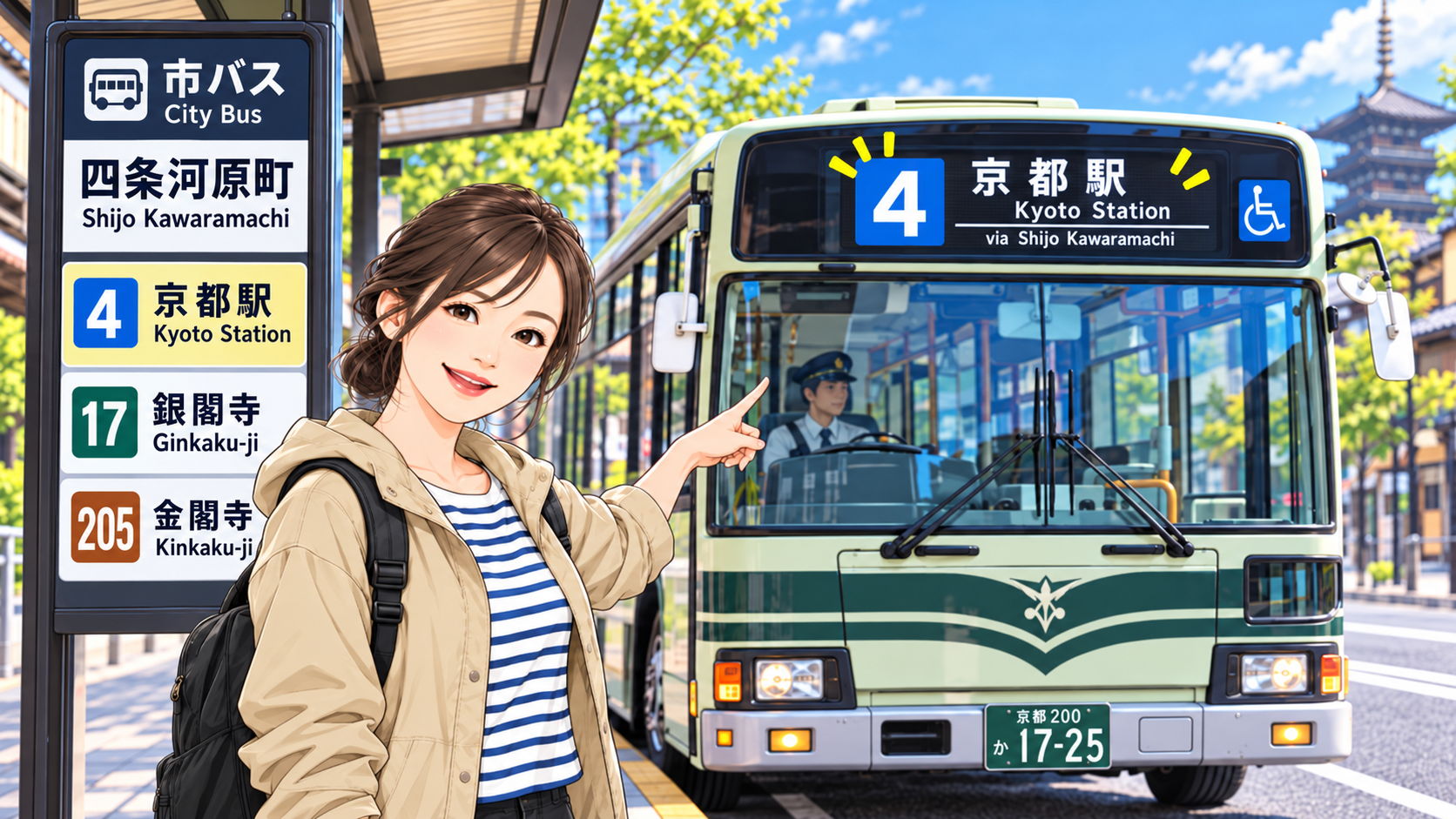
When you arrive at the bus stop, check the route number and destination.
On many buses, the front or side of the bus displays:
- Route number
- Destination
- Major stops along the route
Don’t rely only on the name of the bus stop. Check the destination shown on the bus as well.
It is common to find a stop with the same name on the opposite side of the road for buses traveling in the other direction.
Even if you are using Google Maps or another navigation app, don’t just look for:
“XX Bus Stop”
Also make sure that:
the route number and destination match the bus you need.
Check When to Tap Your IC Card
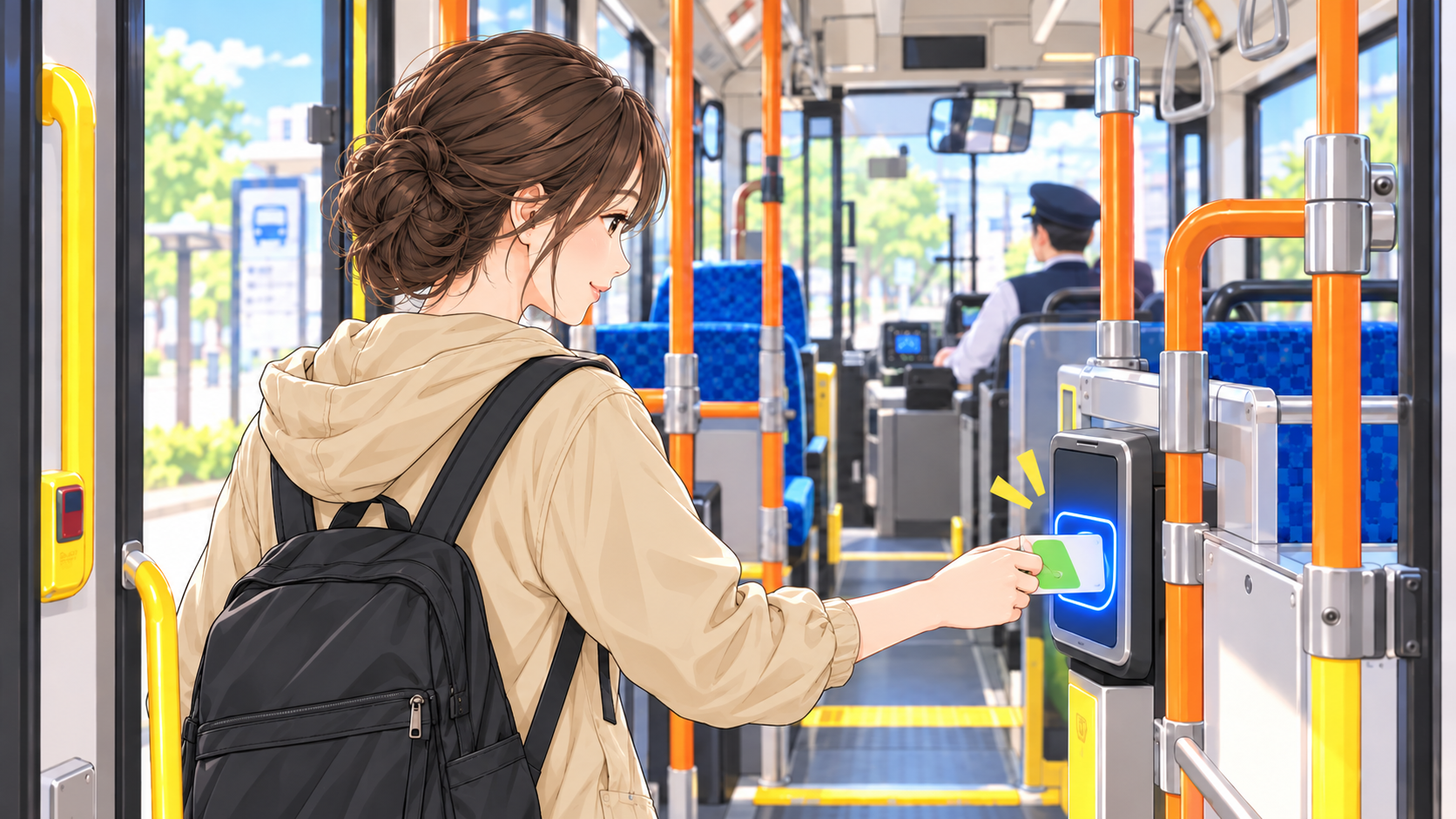
If the bus accepts transit IC cards such as Suica, PASMO, or ICOCA, using one is usually easier than paying with cash.
However,
the number of times you need to tap your IC card depends on the bus.
As mentioned above,
buses that require two taps have IC card readers at both the boarding and exit doors.
Buses Where You Tap Once When Boarding
On buses where you pay when boarding, such as regular Toei buses within Tokyo’s 23 wards, tap your IC card when you get on.
Your fare is paid at that point.
You do not need to tap again when you get off.
Buses Where You Tap Once When Getting Off
On regular Osaka City Bus routes, you do not tap your IC card when boarding.
Board through the rear door, then tap your IC card on the reader next to the fare box at the front when you get off.
Buses Where You Tap When Boarding and Again When Getting Off
On some routes where the fare depends on the distance traveled:
- Tap your IC card when boarding
- Tap it again when getting off
Kyoto City Bus uses this system on some distance-based routes in outlying areas.
When you tap your card as you board,
the stop where you boarded
is recorded on the IC card. That information is then used to calculate your fare when you get off.
If you forget to tap when boarding, the system cannot calculate your fare correctly.
Kyoto City Bus instructs passengers who forget to tap when boarding to tell the driver which stop they boarded at before getting off.
Can You Use Suica or PASMO on Every Bus?
No.
Many buses accept major nationwide-compatible transit IC cards such as Suica, PASMO, and ICOCA.
You can use them on Toei buses in Tokyo, Kyoto City Bus, and Osaka City Bus.
However, they cannot be used on every local bus in Japan.
If you are traveling in a rural area or using a bus company for the first time, check for IC card acceptance before you board.
For that reason,
we recommend carrying both a transit IC card and a small amount of cash.
If you come across a bus that does not accept IC cards, you can still pay with cash.
What If Your IC Card Balance Is Too Low?
The procedure depends on the bus company.
For example, on Kyoto City Bus, if a prepaid IC card such as ICOCA or Suica does not have enough balance,
you can use the remaining balance on the card and pay the difference in cash.
This is not a nationwide rule for all buses in Japan.
If your balance is too low, tell the driver before putting cash into the fare box.
If possible, recharge your IC card at a station or convenience store before getting on the bus.
Can One IC Card Pay for Two or More People?
Some bus companies allow it.
For example, Kyoto City Bus instructs passengers who want to pay for two or more people with one IC card to tell the driver before tapping the card.
The driver adjusts the fare box for the number of passengers, and then you pay with the IC card.
This is not a nationwide rule.
Also, when traveling by train, each passenger generally needs their own ticket or IC card.
For that reason,
if you are traveling in Japan with other people, the easiest option is for each person to have their own IC card.
Think of this as a backup option rather than the standard way to pay.
You May Need a Numbered Ticket When Paying Cash
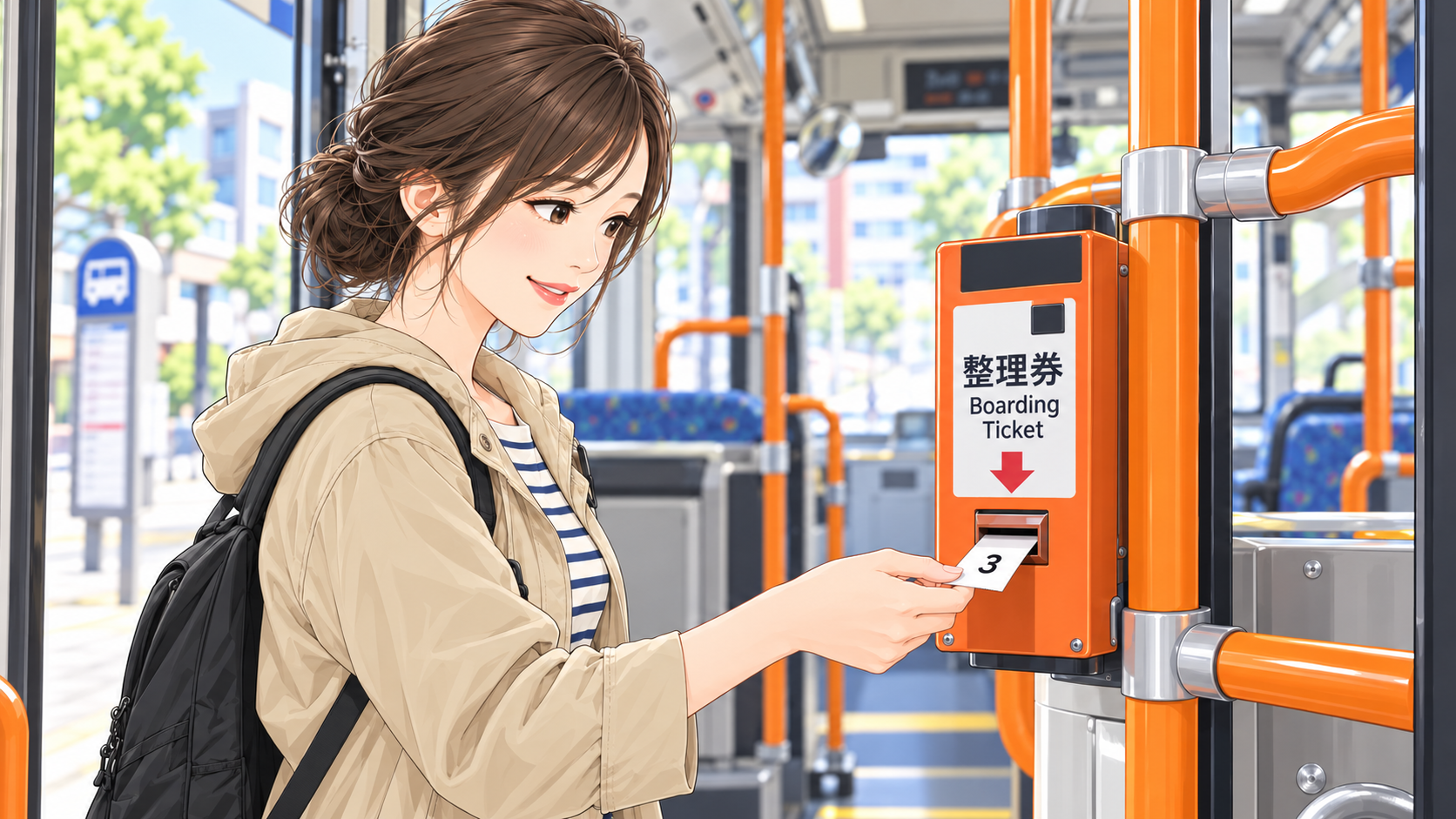
When paying cash on a bus where the fare changes depending on how far you travel, you may need to take a numbered ticket (整理券, seiriken).
A numbered ticket is a small ticket showing where you boarded the bus.
There will be a numbered-ticket machine near the boarding door. Take one ticket from the machine when you get on.
A number is printed on the ticket.
When you are ready to get off, check the fare display at the front of the bus.
For example, if your ticket says “3,”
the amount shown under “3” on the fare display is the adult fare from your boarding stop to your current stop.
When paying cash, put both the numbered ticket and the fare into the fare box.
If there is a numbered-ticket machine by the boarding door and you are paying cash, don’t forget to take a ticket.
If you tap your IC card when boarding, you normally do not need to take a numbered ticket.
How Much Is the Child Fare on Buses in Japan?
Local buses in Japan offer child fares.
However, the exact age categories and rules for how many young children can ride free vary by bus company.
For example, on regular Toei buses within Tokyo’s 23 wards:
- Adult: ¥210 (IC: ¥210)
- Child: ¥110 (IC: ¥105)
On Toei buses, the child fare applies to children age 6 to under 12. A 12-year-old elementary school student still qualifies for the child fare.
For children age 1 to under 6, up to two children can ride free for each accompanying passenger age 6 or older. Infants under age 1 ride free.
On Kyoto City Bus:
- Flat-fare area: Adult ¥230
- Flat-fare area: Child ¥120
On Kyoto City Bus, the child fare also generally applies to children age 6 to under 12. A 12-year-old elementary school student still qualifies for the child fare. Children age 1 to under 6 ride free when accompanied by a parent or guardian.
Children can pay the child fare with a child IC card, such as a child PASMO.
If you are traveling with a child, do not use an adult IC card for the child. Use a child IC card or tell the driver before paying.
If you are paying a child fare in cash, tell the driver before putting the money into the fare box.
On flat-fare routes, the child fare is fixed. On distance-based routes, the child fare is calculated based on the adult fare.
The rules vary by bus company, so if you are unsure, just say, “Child fare, please.”
Don’t Assume the Fare Box Will Give You Change
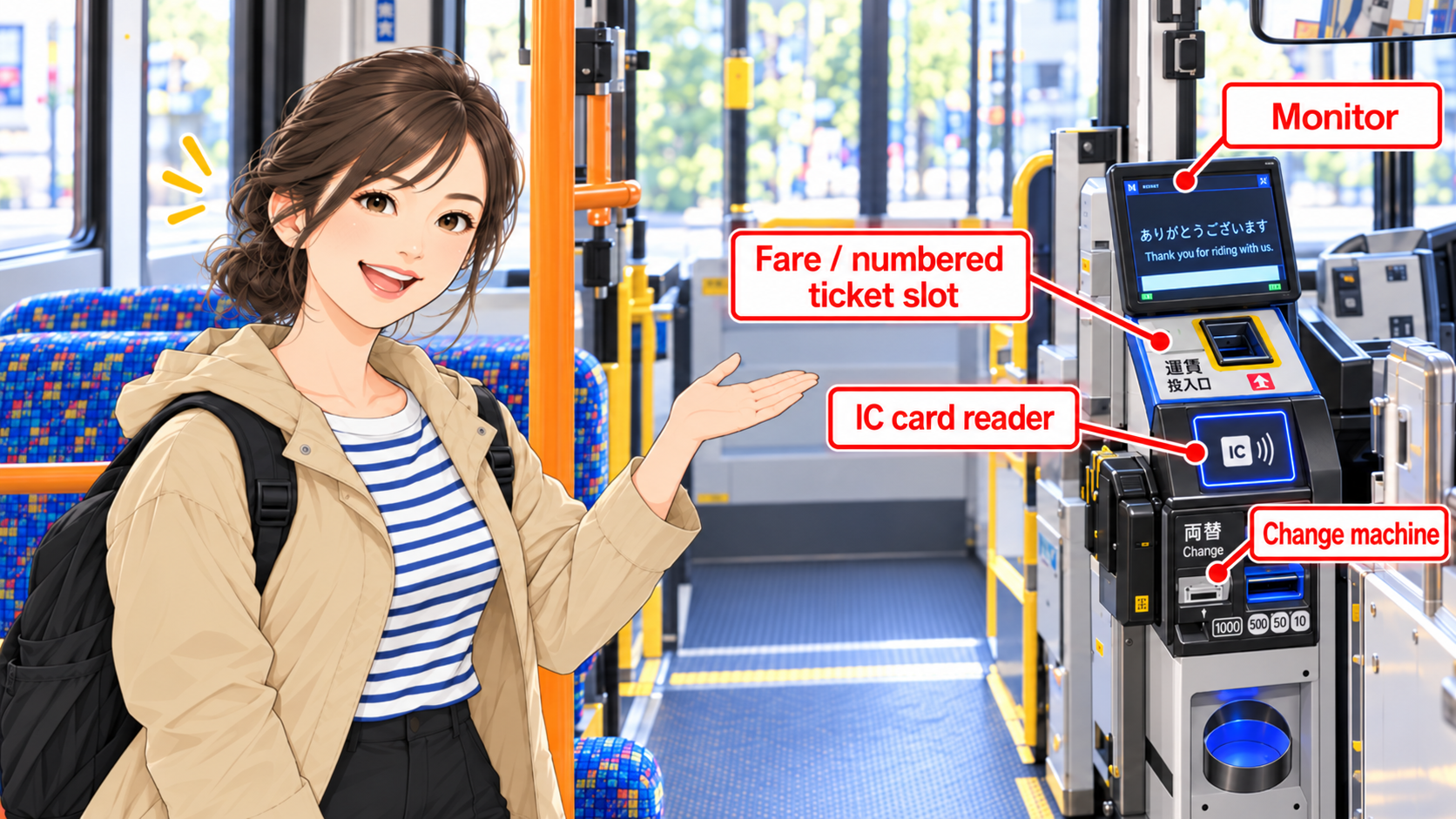
This is one area where you need to be a little careful.
Bus fare boxes in Japan do not all work the same way.
On some buses, you can put in more than the exact fare and the machine will automatically give you change.
On others, the fare box does not give change. You need to use the change machine on the bus first, then pay the exact fare.
On Kyoto City Bus, you can currently put a ¥500 coin or ¥1,000 bill directly into the fare box and receive change.
Osaka City Bus fare boxes also give change.
However, some buses operated by other companies in Kyoto do not give change, so you need to use the onboard change machine first.
Do not assume that every bus in Japan will give you change.
If you plan to pay cash, it is useful to carry:
- ¥1,000 bills
- ¥100, ¥50, and ¥10 coins
On regular local buses, ¥5,000 and ¥10,000 bills generally cannot be used onboard.
Can You Use Contactless Credit Cards on Buses?
More buses are beginning to accept contactless credit card payments.
For example, selected Osaka City Bus routes accept contactless payments with Visa, Mastercard, JCB, American Express, and other supported cards.
However,
not every local bus in Japan accepts contactless credit card payments.
If you are traveling around Japan for several days, we recommend using a transit IC card as your main payment method for local buses and carrying some cash as a backup.
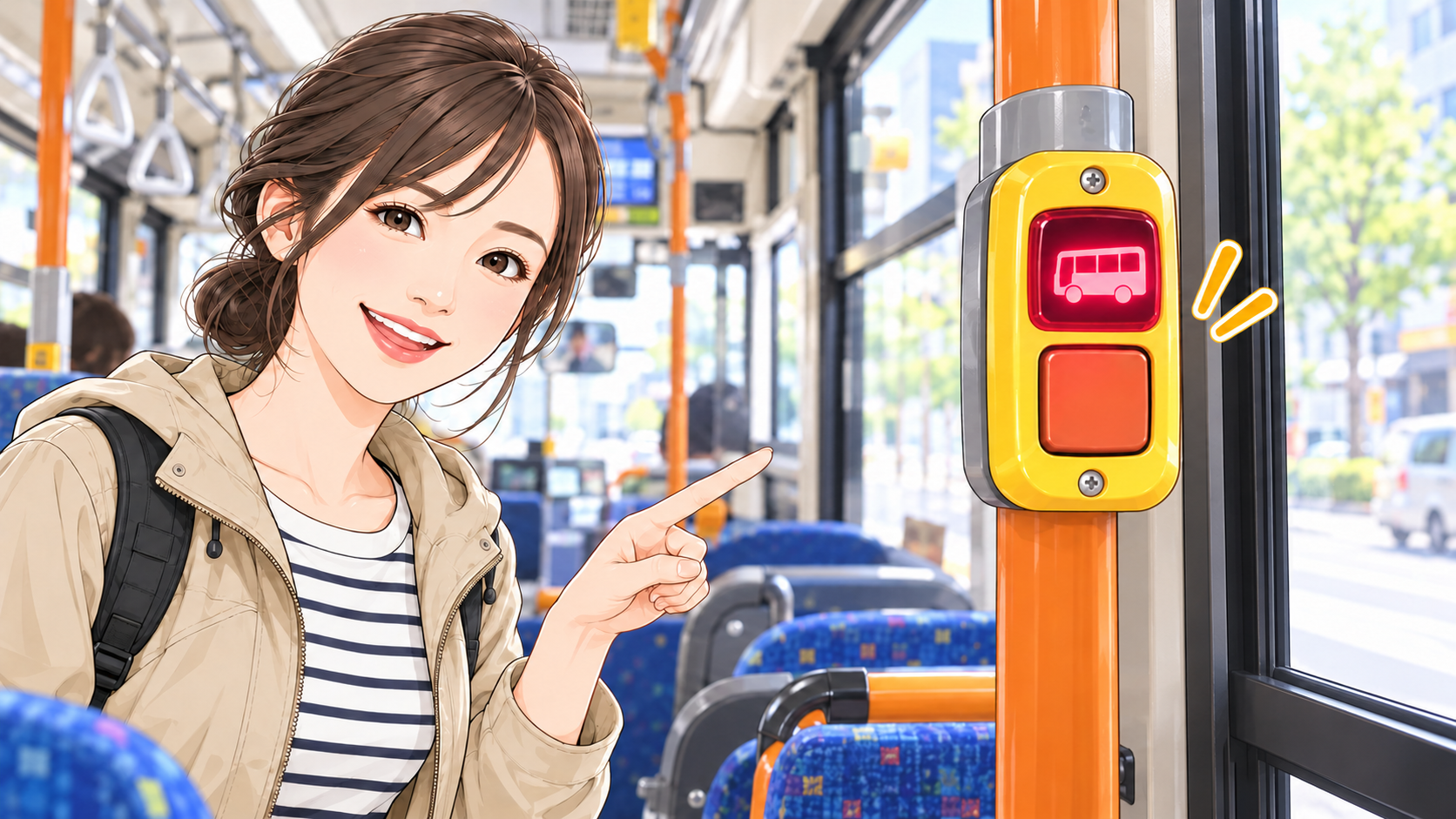
Local buses in Japan do not necessarily stop at every bus stop.
When your stop is announced,
press one of the stop buttons inside the bus.
When you press the button, a light will come on or a sound will play to let the driver know that someone wants to get off at the next stop.
The next stop will also be shown on onboard displays or announced over the speakers.
When your stop is getting close, keep an eye on the display.
You Don’t Need to Move to the Exit While the Bus Is Moving
Pressing the stop button does not mean you need to walk to the exit immediately.
Local buses in Japan can brake suddenly.
Wait until the bus has completely stopped before moving toward the exit.
Kyoto City Bus and Toei Bus in Tokyo also instruct passengers to avoid moving around while the bus is in motion.
If you are standing, hold onto a handrail or hanging strap.
Can You Take a Large Suitcase on a Local Bus?
Bringing a suitcase onto a local bus is not prohibited.
However,
we do not recommend bringing a large suitcase onto a crowded city bus.
A large suitcase can block the aisle and make it harder for other passengers to get on and off.
In Kyoto in particular, the official Kyoto tourism website encourages “Hands-Free Travel,” asking visitors to avoid bringing bulky luggage onto buses and trains and to use luggage storage or delivery services instead.
Hands-Free Travel in Kyoto | Kyoto City Official
If you have a large suitcase when traveling to or from your hotel, consider:
- Airport limousine buses
- Trains
- Taxis or private airport transfers
- Luggage delivery services
When sightseeing, traveling with only a small bag will make getting around much easier.
If you have a large suitcase, another option is to use a private vehicle between the airport and your hotel.
Kiwitaxi lets you book transfers between the airport and your hotel in advance.
You enter your pickup location and destination when booking, which means you can avoid looking for a taxi stand after arrival or having to explain your destination to the driver.
You can also add a child seat or booster seat based on your child’s age and size.
This can be especially useful for:
- Travelers with large luggage
- Families with young children
- Groups traveling together
- Travelers who want to arrange their airport–hotel transfer in advance
Find an Airport Transfer in Japan with Kiwitaxi
If you’re traveling light and a regular taxi is all you need, simply taking one on the spot is perfectly fine.
First Time Taking a Bus in Japan? Check These 3 Things
You do not need to memorize the detailed rules of every bus company in Japan before your trip.
When the bus arrives, check these three things first:
- Do you board from the front or rear? (Use the door that opens for boarding.)
- Do you pay when boarding or when getting off? (If the fare is paid upfront, pay when you board.)
- Do you need to tap your IC card when boarding? (If there is an IC card reader at the boarding door, tap it.)
Once you know those three things, the rest is straightforward.
After boarding, the basic flow is:
Check the onboard display or announcement → press the stop button → pay if necessary → get off
And if this is your first time using buses in Japan,
carry a transit IC card such as Suica, PASMO, or ICOCA, plus a ¥1,000 bill and some coins.
If the bus accepts IC cards, tap your card.
If it does not, pay cash.
With those two options, you can handle most situations.

Don’t try to memorize one nationwide rule such as “always board at the front” or “always pay when you board.”
That’s the most important thing to remember if you want to avoid confusion on buses in Japan.
More Guides to Getting Around Japan



Ready to plan your trip?
Find flights, hotels, transportation, tours, and attraction tickets below.
Flights
Search Flights to Japan
Hotels
Find Hotels in Japan
Airport Transfer
Book an Airport Transfer
Private Car Charter
Travel with a Private Driver
Tours & Experiences
Explore Tours in Japan
Attraction Tickets
Find Tickets in Japan

Explore tours, experiences, and attraction tickets to discover even more ways to enjoy Japan.
Why not take a look and see what’s waiting for you in Japan?