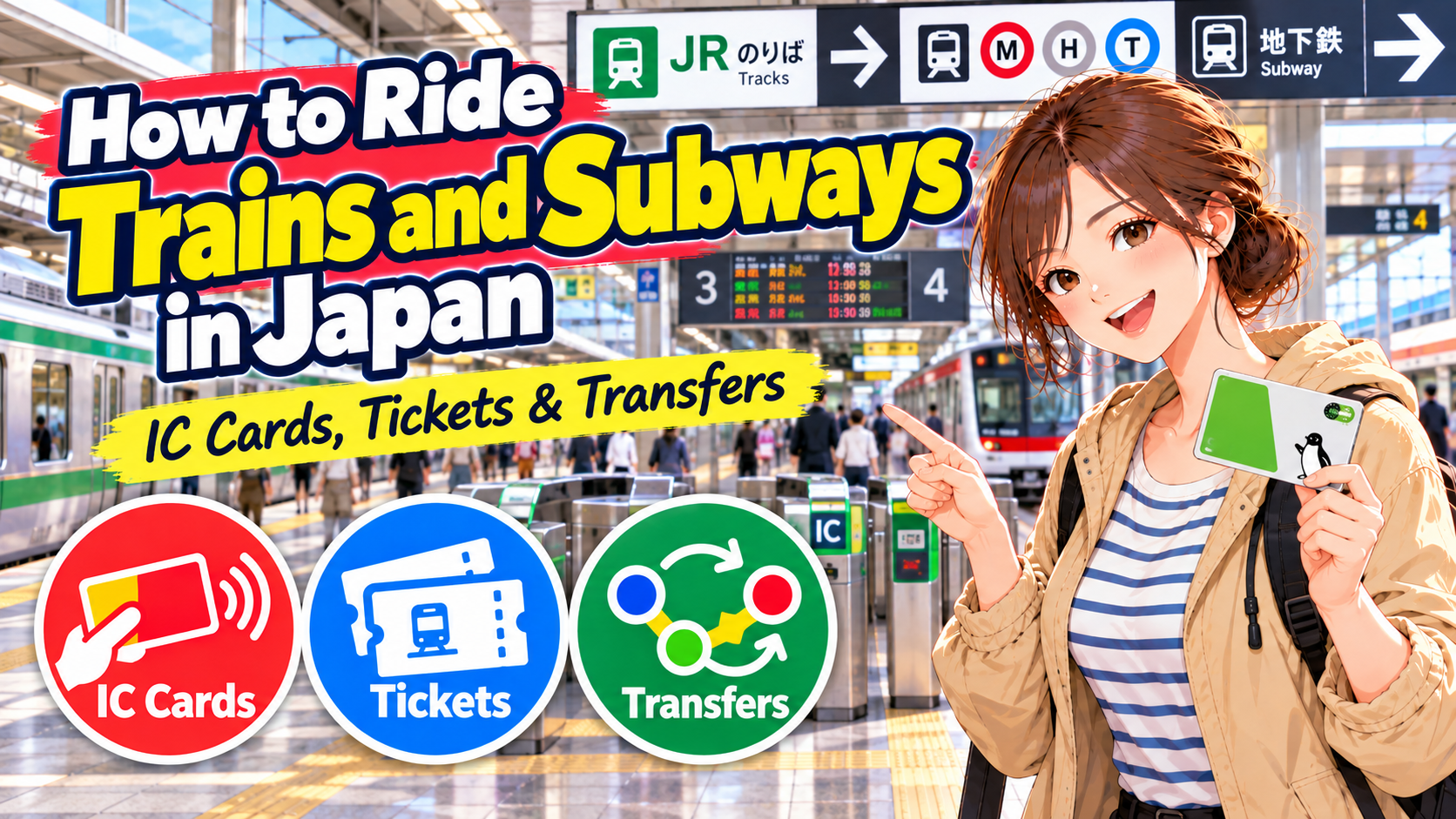
Japan has so many train and subway lines that the system can seem complicated if you're visiting for the first time.
In cities like Tokyo and Osaka, several railway companies may serve the same station, making it hard to know which train to take.
But the basics of riding trains in Japan are actually pretty simple.
Look up your route on Google Maps or another route planner, enter the ticket gates with an IC card or a paper ticket, and board your train from the correct platform.
That's the basic process to remember.
With a transportation IC card such as Suica, PASMO, or ICOCA, you won't need to buy a ticket every time you ride a train on a supported line.
In this guide, I'll explain the differences between trains and subways, how to navigate stations, how to use tickets and IC cards, how to transfer, and how to find the right exit.
Shinkansen (bullet trains) have different ticketing and reservation systems, so I'll cover them in a separate guide.
What Types of Trains and Subways Are There in Japan?
Japan has several kinds of rail services, including conventional JR lines, private railways, subways, and Shinkansen bullet trains.
This guide focuses on conventional JR trains, private railways, and subways—the ones you'll commonly use to get around cities and visit attractions.
The Differences Between JR, Private Railways, and Subways
- JR: A group of railway companies operating trains across Japan. Tokyo's Yamanote Line and Osaka Loop Line are both JR lines.
- Private railways: Privately operated railway companies other than JR, such as Odakyu Electric Railway, Tokyu Railways, Keio Corporation, Kintetsu Railway, and Hankyu Corporation.
- Subways: Rail systems that run mainly underground in urban areas, such as Tokyo Metro, Toei Subway, and Osaka Metro.
For example, Tokyo has two subway operators: Tokyo Metro and Toei Subway.
Although they're both subway systems, they have different operators, so fares and eligible tickets can differ.
You don't need to memorize every railway company.

Look up your route, then use the railway company and line shown in the directions.
Subways Don't Always Stay Underground
You might assume that subways always run underground, but some Japanese subway lines also have aboveground sections.
Some subway trains also continue directly onto private railway or JR tracks. This is called through service, and it lets you travel onto another company's line without changing trains.
Even when the operator or line name changes along the way, you may not need to get off.
If your route planner shows that no transfer is needed, you may be able to stay on the same train.
Check Your Route on Google Maps Before Boarding
Before taking a train in Japan, start by checking your route on Google Maps or another transit-planning app.
Enter your starting point and destination, then choose public transit. You'll see details such as the lines to take, transfer stations, travel time, and fares.
Depending on the station, the app may also show a platform number or a recommended exit.
At major stations like Tokyo Station and Shinjuku Station, it can take several minutes or more just to walk from the entrance to your platform.
If Google Maps shows a train's departure time, arriving at the station at that exact time will be too late.

Give yourself extra time, especially when you're using a station for the first time.
Five Things to Check Before You Go
- Railway company and line: Are you taking JR, the subway, or another railway? Which line do you need?
- Boarding station: Stations with the same name may have separate ticket gates for different operators.
- Platform number and direction: Which platform do you need, and which direction is the train going?
- Train service: Is it a Local, Rapid, Express, or Limited Express train?
- Transfers and exits: Where do you need to change trains, and which exit is closest to your destination?
The Fastest Route Isn't Always the Best One for Visitors
Suppose one route takes 30 minutes with two transfers, while another takes 40 minutes without any transfers.
If you're not familiar with Japan's rail system, I'd recommend the 40-minute route without transfers.
Changing trains can take time, especially with a suitcase or when passing through large stations like Tokyo or Shinjuku.
Even if the journey takes a little longer, choose a route with fewer transfers.
That's one of my tips for getting around Japan by train.
How Do You Pay for Trains and Subways in Japan?
Most trains and subways in Japan accept transportation IC cards or paper tickets for fare payment.
If you plan to ride trains several times during your trip, I recommend using a transportation IC card.
1. How to Ride with an IC Card
Some of the most commonly used transportation IC cards in Japan are:
- Suica
- PASMO
- ICOCA
These cards are issued by different operators, but you can use them interchangeably on railways that support nationwide IC card interoperability.
Here's how to use one:
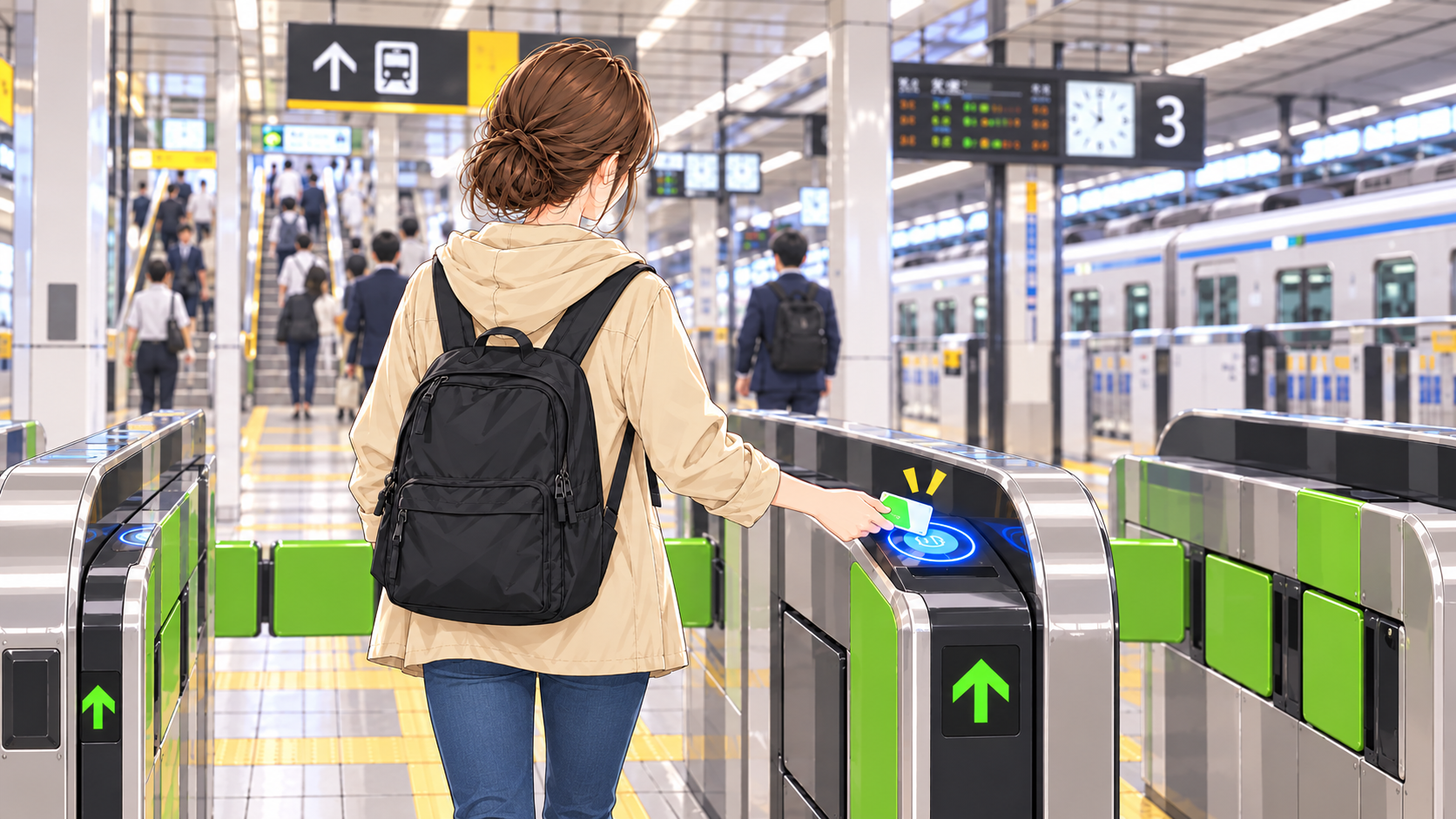
- Tap your IC card on the reader at the ticket gate when entering the station.
- Board your train.
- Tap the same card at the ticket gate when you leave your destination station.
On supported regular train services, the fare is calculated automatically and deducted from your card balance.
You won't have to look up the fare and buy a ticket before each trip.
Each passenger needs their own IC card.
You can't use a single card to take two people through the ticket gates.
If a child is eligible for a child fare, use a child IC card or another appropriate ticket for their age.
IC Cards Don't Work on Every Railway in Japan
Transportation IC cards such as Suica and ICOCA work on many railways across Japan, but some journeys cannot be made across different IC card service areas using a single card.
Before you travel, open the IC card service area map on the railway operator's official website. Check whether both your departure and arrival stations are within the same service area.
If your journey crosses different IC card service areas, buy a ticket to your destination before boarding.
JR East: Suica Service Area (English)
JR Central: TOICA Service Area
2. How to Ride with a Paper Ticket
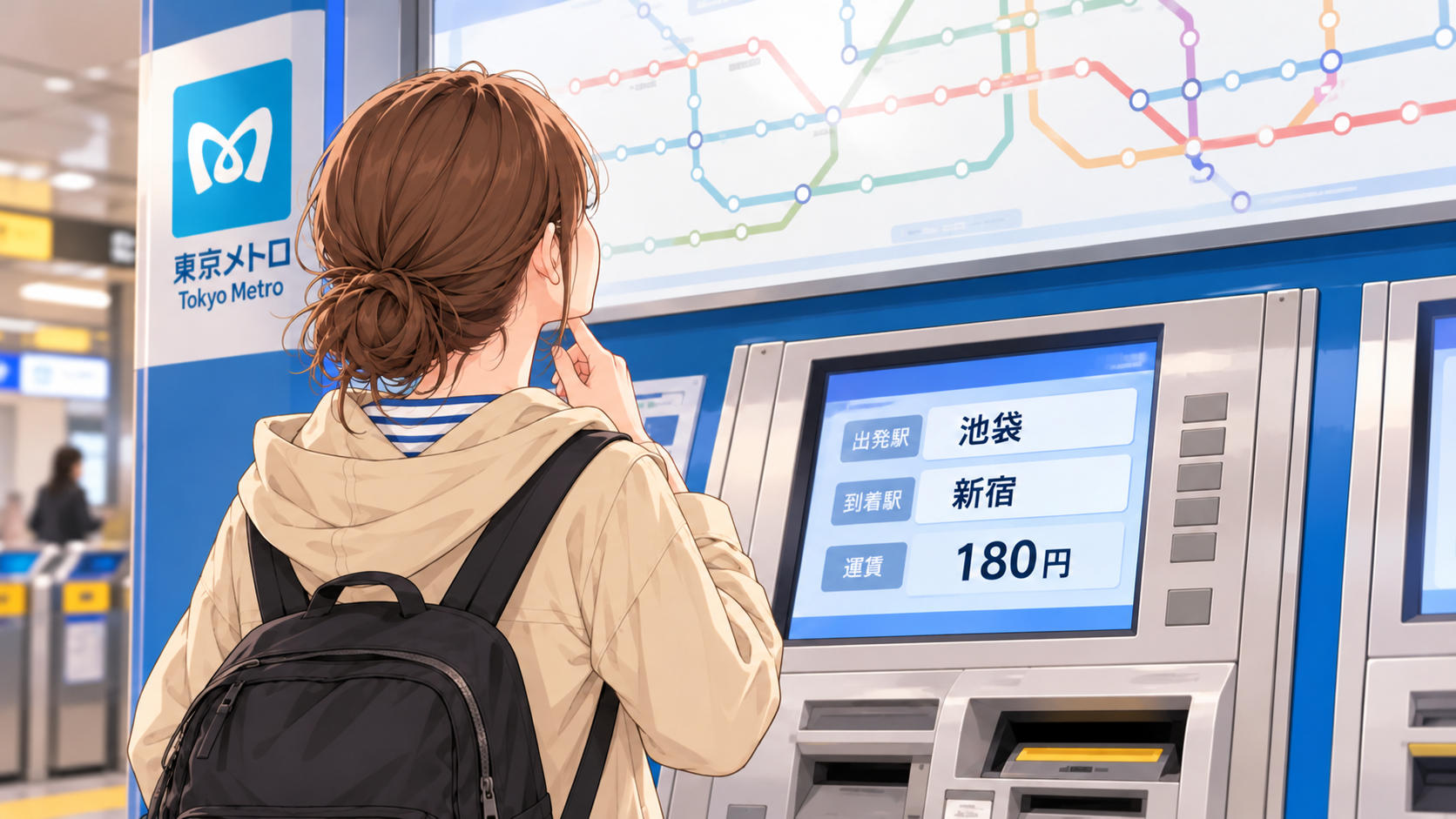
You can still ride trains without an IC card by buying a paper ticket.
For most short trips, you can buy your ticket from a ticket machine at the station.
- Check the fare to your destination on the fare chart above the machine or on its screen.
- Select your destination or the appropriate fare on the ticket machine.
- Pay the amount shown.
- Collect your ticket from the machine.
Some ticket machines let you switch the display to English.
Insert your ticket into the slot at the automatic ticket gate.
When you enter the station, the ticket comes back out of the gate. Don't forget to pick it up.
You'll need that ticket again when you leave the station.
Insert it into the exit gate at your destination. A standard one-way ticket will normally be collected by the machine.
3. Can You Tap a Credit Card Directly at the Ticket Gate?
More railway lines in Japan now accept contactless credit or debit cards for train fares.
For example, on March 25, 2026, several railway operators in the Kanto region, including Tokyo Metro, began allowing contactless fare payments across their participating networks.
However, you cannot use contactless credit card payments on every railway in Japan.
For example, there are routes where you cannot travel all the way from Tokyo Metro onto JR East using only this payment method.
Also, the reader for transportation IC cards may be separate from the reader for contactless credit card payments.
If you want to pay by tapping your credit card, check the eligible lines and stations on the railway operator's official website.
Tokyo Metro, for instance, generally supports this method across its entire network, but it does not support through journeys onto JR East using contactless credit card payment.
At the station, use a gate fitted with a dedicated contactless credit card reader. On Tokyo Metro, these readers are mainly installed at wider gates, such as those near information counters.
If you can't find a compatible gate, ask a station attendant.
Tokyo Metro: Tap to Ride Service
When paying with a contactless credit card, use the same card or the same smartphone when entering and leaving the station.
You cannot enter with a physical credit card and exit with a smartphone that has the same card registered on it.
How to Ride Trains and Subways in Japan: Step by Step
Now I'll walk you through the process, from arriving at the station to passing through the ticket gates at your destination.
STEP 1: Find the Entrance to Your Railway Line
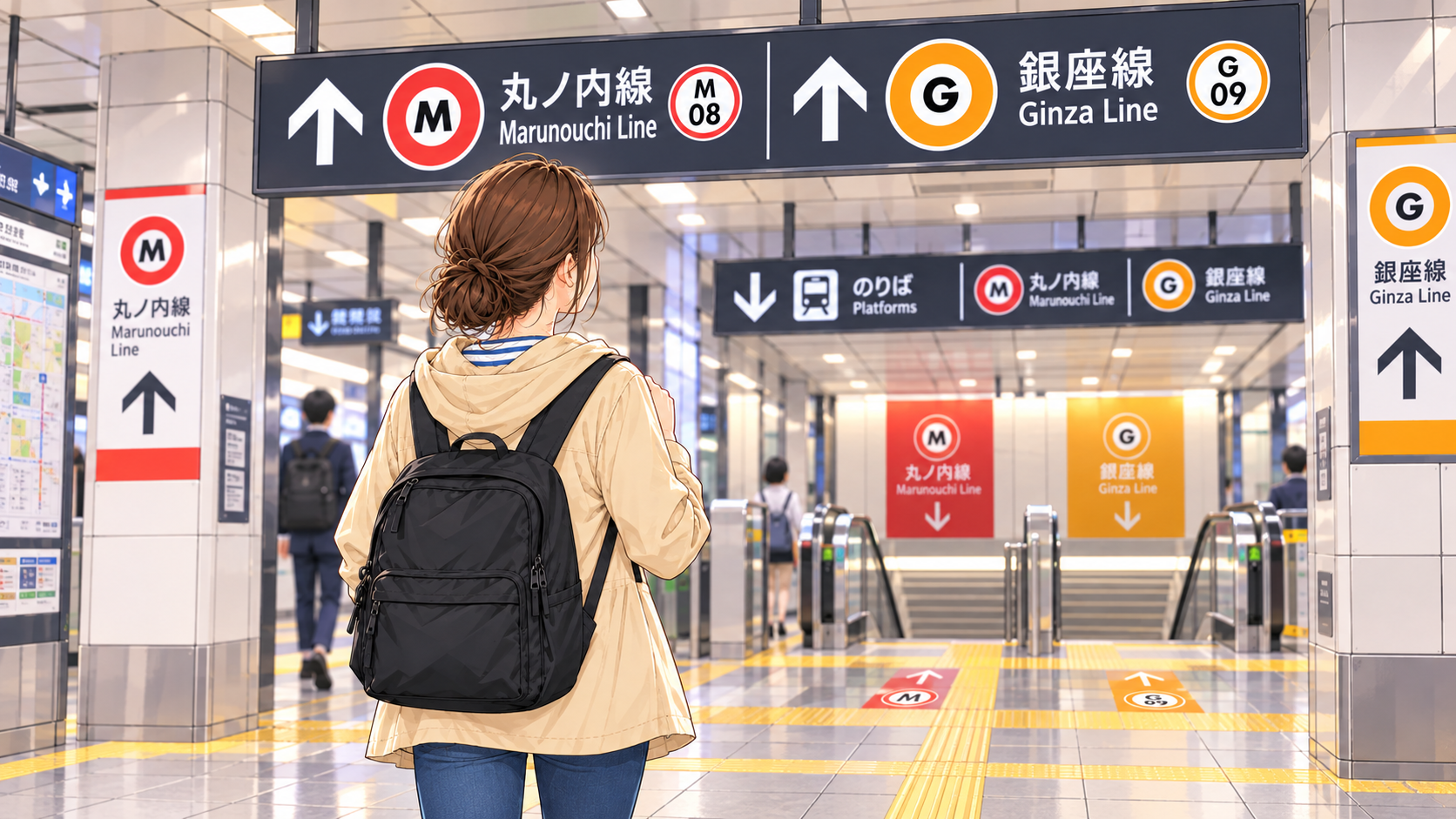
At major stations, the entrances for JR, private railways, and subways may be far apart.
For example, even if both places are labeled "Shinjuku Station," the JR and Tokyo Metro stations have different ticket gates and platforms.
When you arrive, first check the railway operator and line name shown in your route-planning app.
Then follow the signs inside the station.
At major stations in Japan, railway lines are identified by colors, letters, and other symbols.
On Tokyo Metro, for example, the Marunouchi Line uses the letter "M" and the Ginza Line uses "G." You can also use the station numbers to find your way.
There are signs in English too, so you can find your way even if you can't read Japanese.
STEP 2: Go Through the Ticket Gates
Once you've reached the ticket gates for your line, enter using an IC card or a paper ticket.
- IC card: Tap it on the IC card reader at the gate.
- Paper ticket: Insert it into the ticket slot, then collect it when it comes back out as you pass through.
If the gate doesn't open, don't try to force your way through. Ask a station attendant for help.
Possible causes include insufficient IC card balance, a problem with your entry record, or a restriction on the service area.
STEP 3: Find the Platform for the Right Direction
Once you're through the gates, follow the station signs to your platform.
The important thing is to check not just the line name, but also which direction the train is going.
If you go to the platform for the opposite direction, you'll be traveling away from your destination.
Platform signs show train destinations and major stops.
For example, if you're taking the Tokyo Metro Ginza Line from Ginza Station to Asakusa Station, board a train heading toward Asakusa.
Once you've found your line, check the direction, platform number, and train service type.
Keep in mind that the same platform number can refer to completely different platforms run by different railway operators.
If you see "Platform 2" at a large station, make sure it's Platform 2 for the correct railway company.
STEP 4: Check Whether It's a Local, Rapid, Express, or Limited Express
Trains running on the same line don't always stop at the same stations in Japan.
Here are the main service types:
- Local (普通・各駅停車): Generally stops at every station.
- Rapid (快速): Skips some stations.
- Express (急行): Stops at fewer stations than a Local train.
- Limited Express (特急): Stops at selected stations. Some services require an additional charge or a separate ticket.
Many Local, Rapid, and Express trains can be used with the regular fare, but fare rules vary between railway operators.
Limited Express services deserve special attention.
For example, JR Limited Express trains and Odakyu's Romancecar require a limited express ticket in addition to the regular base fare.
However, some private railways have trains called "Limited Express" that don't require a limited express surcharge.
In other words, you can't tell whether there's an extra charge just from the words "Express" or "Limited Express."
If a service requires a "Limited Express Ticket" (特急券) or a "Reserved Seat Ticket" (指定席券), there are trains or seats you can't use with only a regular ticket or IC card.
For example, regular Limited Express trains on Keio don't require an extra fare, while Odakyu's Romancecar requires a separate limited express ticket.
On the operator's official website, open the "Fares" or "How to Ride" section and check whether a Limited Express Ticket or Reserved Seat Ticket is required.
Keep in mind that the fare displayed on Google Maps may not always tell you whether an additional ticket is needed.
How Can You Tell Whether a Train Stops at Your Station?
Start by looking at the electronic departure board on the platform.
It shows details such as the service type (Local, Rapid, Express, and so on), destination, departure time, and platform number.
Next, look for a stopping-station chart on the platform and check whether your destination is listed for that train.
If you can't find the stopping-station information, enter your starting point and destination in Google Maps. Compare the service type and departure time in your route details with the platform's electronic departure board.
You can also check train services and stopping stations using the route planner on the railway operator's official website.
Rapid and Express trains can skip your station. Even if the destination shown on the train looks right, make sure it actually stops where you want to get off.
STEP 5: Line Up on the Platform and Board
Platforms have markings that show where the train doors will open.
Line up at those markings and wait for the train to arrive.
When the train arrives, let passengers get off first.
Once everyone has finished getting off, board in order.
Wait in a safe place behind the yellow tactile paving, and don't rush onto a train as the doors are closing.
Once you're on board, check the information displays inside the car.
On major lines, screens above the doors and elsewhere show the next stop and connecting lines.
STEP 6: Get Off at Your Destination Station
As your destination approaches, check the onboard displays and listen to the announcements.
On major railway lines in Japan, station announcements are also made in English.
When you reach your station, get off and follow the signs for the exit or your transfer.
The key is to know the difference between "Exit" (出口) and "Transfer" (乗り換え).
If you still need to change trains, you may not need to leave the station yet.
STEP 7: Exit the Ticket Gates and Find the Best Station Exit
When you've reached your final station and don't need to transfer, go through the exit ticket gates.
If you're using an IC card, tap the same card you used to enter.
If you're using a paper ticket, insert it into the ticket gate.
At major stations in Japan, though, there can be several different street exits beyond the ticket gates.
Some exits can leave you with a much longer walk, so check the exit number as explained below.
How Do Train Transfers Work in Japan?
Transfers are one of the things that can confuse first-time visitors.
In Japan, there are two main ways to transfer between trains.
1. Transfers Without Leaving the Ticket Gates
When switching between lines operated by the same railway company, you may be able to transfer without going through an exit gate.
In that case, follow the "Transfer" signs inside the station to the next platform.
You won't need to buy another ticket or tap your IC card again during that transfer.
Some transfers do involve passing through ticket gates, however, so always follow the station signs.
2. Transfers That Require Leaving and Reentering the Gates
When transferring from JR to a subway line, for example, you may need to exit one operator's ticket gates and enter another operator's gates.
If you're using an IC card, you'll generally tap it at each set of gates.
Even when transferring between two Tokyo Metro lines, some stations require you to pass through ticket gates.
At some Tokyo Metro stations, there are special orange ticket gates for passengers transferring with paper tickets.
When you go through an orange transfer gate with a paper ticket, the gate returns your ticket.
Take the ticket with you and enter the gates for your connecting line within 60 minutes.
Ordinary exit gates and designated transfer gates work differently, so be especially careful if you're using a paper ticket.
How Much Time Should You Allow for a Transfer?
Transfer times vary considerably from station to station.
At some stations, the next train is on the adjacent platform. At others, you may have a long walk through underground passageways.
Allow extra time for transfers, especially when you're carrying a suitcase or other luggage.
Check the Exit Number: Finding Your Way Out of the Station
At some large stations in Japan, finding your way out can feel harder than getting off the train.
For example, subway exits in Tokyo may be labeled with letters and numbers such as "A1," "A2," or "B1."
Station maps show the streets and nearby buildings or facilities accessible from each exit.
If Google Maps suggests an exit number when you check your route, make a note of it.
After going through the ticket gates, follow the signs to that exit.
At large stations, choosing the wrong exit can mean a long detour to your destination.
Don't just head for the first exit you see. Check which exit is closest to where you're going.
If an app's directions don't match the signs at the station, follow the signs on site.
If your chosen exit is closed for construction or another reason, use a different exit.
At big stations, pay attention to where you leave your luggage in a coin locker, too.
There are lots of similar-looking lockers, and I've had trouble finding the one where I left my belongings.
When you store luggage, I recommend taking a photo of the locker number, a nearby exit number, or another landmark with your phone.
What If You Have Trouble Using Trains or Subways?
Here are some common problems travelers run into, along with what to do if they happen.
What If Your IC Card Doesn't Have Enough Balance?
If your IC card balance is too low, you may not be able to pass through the ticket gates.
If you don't have enough money on your card before entering, top it up at a ticket machine or another supported charging point, then go through the gates.
If your balance runs out when you reach your destination, top up at a fare adjustment machine near the gates or ask a station attendant for help.
Standard physical Suica cards need cash for top-ups.
I recommend carrying a small amount of cash during your trip.

What If Your Paper Ticket Doesn't Cover the Full Fare?
If you bought a paper ticket that doesn't cover the fare to your destination, pay the difference at your arrival station.
On Tokyo Metro, you can insert your ticket into a fare adjustment machine near the gates to see the amount you owe.
Pay the amount shown, collect the adjusted ticket, and use it to pass through the gate.
There's no need to try to force your way through the gates.
What If You Board the Wrong Train?
First, check where the train stops next.
Get off at that station and look up a new route to your destination.
However, don't assume you can simply travel back along the section you rode by mistake without making a fare adjustment.
If your mistake affects the fare, explain what happened to a station attendant and ask how to pay any difference.
What If You Miss Your Train?
If you miss your train, check the electronic departure board for the next service.
If the next train stops at your destination, you can take that one instead.
However, if a train requires a Limited Express Ticket or Reserved Seat Ticket, you may not be able to use that ticket on a different service.
What If Google Maps Disagrees with the Station Signs?
Google Maps can help with platform numbers and departure times, but service changes may mean its information differs from what you see at the station.
In that case, check the station's electronic departure boards and announcements.
Your phone's location may also be inaccurate underground.
If you're worried about losing your directions, take a screenshot of your route before boarding.
What If You Go Through the Wrong Ticket Gate?
If you haven't passed through the gate yet, just head to the correct gate for your railway company and line.
If you've already entered through the wrong gate with an IC card or a paper ticket, tell a station attendant.
They may need to adjust your entry record or handle your ticket.
However, if you can reach the correct line's platform from within the same gated area, you can follow the signs and continue without exiting.
What If You Miss the Last Train?
Trains and subways in Japan generally don't operate 24 hours a day.
Many lines stop running late at night and resume service the following morning.
Last-train times vary by line, destination, and day of the week.
If you plan to stay out late, check the last train back in advance.
If you miss it, you'll need another plan, such as taking a taxi, walking, or staying somewhere nearby.

Train and Subway Etiquette in Japan
When riding trains in Japan, be considerate of the people around you.
Here are some key etiquette tips for visitors:
- Phone calls: Avoid making calls on board, and put your phone on silent.
- Priority seating: Give priority to people who need a seat, such as older passengers, pregnant passengers, and passengers with disabilities.
- Boarding: Let passengers get off before you board.
- Large luggage: Don't block aisles or doorways with your bags.
- Platforms: Don't run, and wait in the designated boarding area.
Some lines also have women-only train cars.
Eligibility and operating times vary by railway company, so check the signs on the platform or train car.
Should You Use an IC Card or a Paper Ticket?
If you'll be taking trains or subways several times during your Japan trip, I recommend using a transportation IC card such as Suica, PASMO, or ICOCA.
On supported routes, it saves you from buying a ticket for every journey and makes transfers easier.
If you'll rarely use the train, or you're traveling on a line that doesn't accept IC cards, paper tickets are a perfectly good choice.
If you'll be riding the subway several times in one city, a one-day pass or another unlimited-ride ticket may save you money.
However, every pass has its own restrictions on which lines you can use.
For example, the Tokyo Subway Ticket covers Tokyo Metro and Toei Subway lines, but not JR's Yamanote Line.
Before buying a pass, check the lines you plan to use on Google Maps and compare them with the "Valid Lines" or "Coverage Area" listed on the pass's official website.
Also compare the price of the pass with the total regular fares for your planned journeys.
If you plan to use lines outside the pass's coverage, paying the regular fare with an IC card may be more convenient.
Summary: How to Ride Trains and Subways in Japan
If you're taking trains or subways in Japan for the first time, remember these steps:
- Look up your route: Use Google Maps or another route planner to check the lines, transfers, and the exit closest to your destination.
- Find the right entrance: Check whether you're taking JR, a private railway, or the subway.
- Go through the gates: Tap your IC card or insert your paper ticket.
- Check your train: Confirm the platform, direction, stops, and whether an additional ticket is needed.
- Travel to your destination: Transfer if necessary, then get off at the correct station.
- Find the right exit: Pass through the ticket gates and follow the signs to the exit nearest your destination.
The rail network may seem complicated at first, but you don't have to memorize every line.
Start by looking up your route, then follow the signs at the station and check that they match your directions.
If you get confused, don't rush. Ask a station attendant for help.
Even if you're new to Japan's rail system, knowing the basics will give you many more ways to explore during your trip.


Ready to plan your trip?
Find flights, hotels, transportation, tours, and attraction tickets below.
Flights
Search Flights to
Japan
Hotels
Find Hotels
in Japan
Airport Transfer
Book an Airport
Transfer
Private Car Charter
Travel with a Private
Driver
Tours & Experiences
Explore Tours in
Japan
Attraction Tickets
Find Tickets
in Japan

Explore tours, experiences, and attraction tickets to discover even more ways to enjoy Japan.
Why not take a look and see what’s waiting for you in Japan?