
Want to ride a tram in Japan but aren’t sure whether to board through the front or rear door, when to pay your fare, or how to pay? It can be confusing at first.
Think you can use Suica or PASMO on every train in Japan?
Actually, some trams accept these transit IC cards, while others don’t.
In some cities, you tap your card both when you board and when you get off. In others, you only tap when you get off.
First, check the fare and accepted payment methods for the place you’re visiting.
This guide explains exactly how to ride trams, how to pay, and what changes from city to city.
🚋 Check Payment Methods for Trams and LRT Across Japan
Note: “Suica and similar cards” refers to transit IC cards that work across participating systems nationwide, including Suica, PASMO, and ICOCA.
Note: Contactless credit card payment means tapping an accepted credit card directly on a dedicated reader at a station or on board. This does not include buying tickets with a credit card at a ticket machine or in an app.
Note: ○ = Accepted; × = Not accepted; — = Direct contactless card payment could not be confirmed through official information.
Note: Links lead to official English pages where possible, though some are official Japanese-language pages. Check the relevant official page for final confirmation.
Note: Enoshima Electric Railway (Enoden) is a railway line rather than a typical tram service, but it is included because part of its route runs on the road. Boarding and exiting are handled at station ticket gates.
Note: This list covers trams, LRT systems, and certain rail lines with street-running sections, grouped by operator or route network. It does not list every individual service.

I’ll walk you through what to do from the moment you arrive at the stop until you get off at your destination, even if it’s your first time riding a tram.
- How to Ride Trams in Japan: 5 Steps
- 3 Ways to Pay for Trams in Japan
- City-by-City Comparison: Tram Fares and IC Card Use
- What to Know in Hiroshima, Nagasaki, Kumamoto, Kagoshima, and Other Cities
- What If Something Goes Wrong on a Tram?
- What Are Trams in Japan, and Where Can You Ride Them?
- What to Remember Before Riding a Tram in Japan
- More Guides to Getting Around Japan
How to Ride Trams in Japan: 5 Steps
Here’s the basic process.
- Find the route and destination for your trip
- Wait at the correct tram stop
- Board through the designated door
- Watch for your stop and press the stop button if needed
- Pay your fare and get off
Let’s go through each step.
① Find the Right Route and Destination
First, enter your starting point and destination in Google Maps. Select “Directions,” then choose “Transit.”
If a tram route appears in the search results, check the following:
- The name of the stop where you’ll board
- The name of the stop where you’ll get off
- The route or service number
- The destination displayed on the tram
- Whether you need to transfer
Several tram routes may serve the same stop.
For example, even if trams depart from the same stop, they don’t necessarily all go in the same direction.
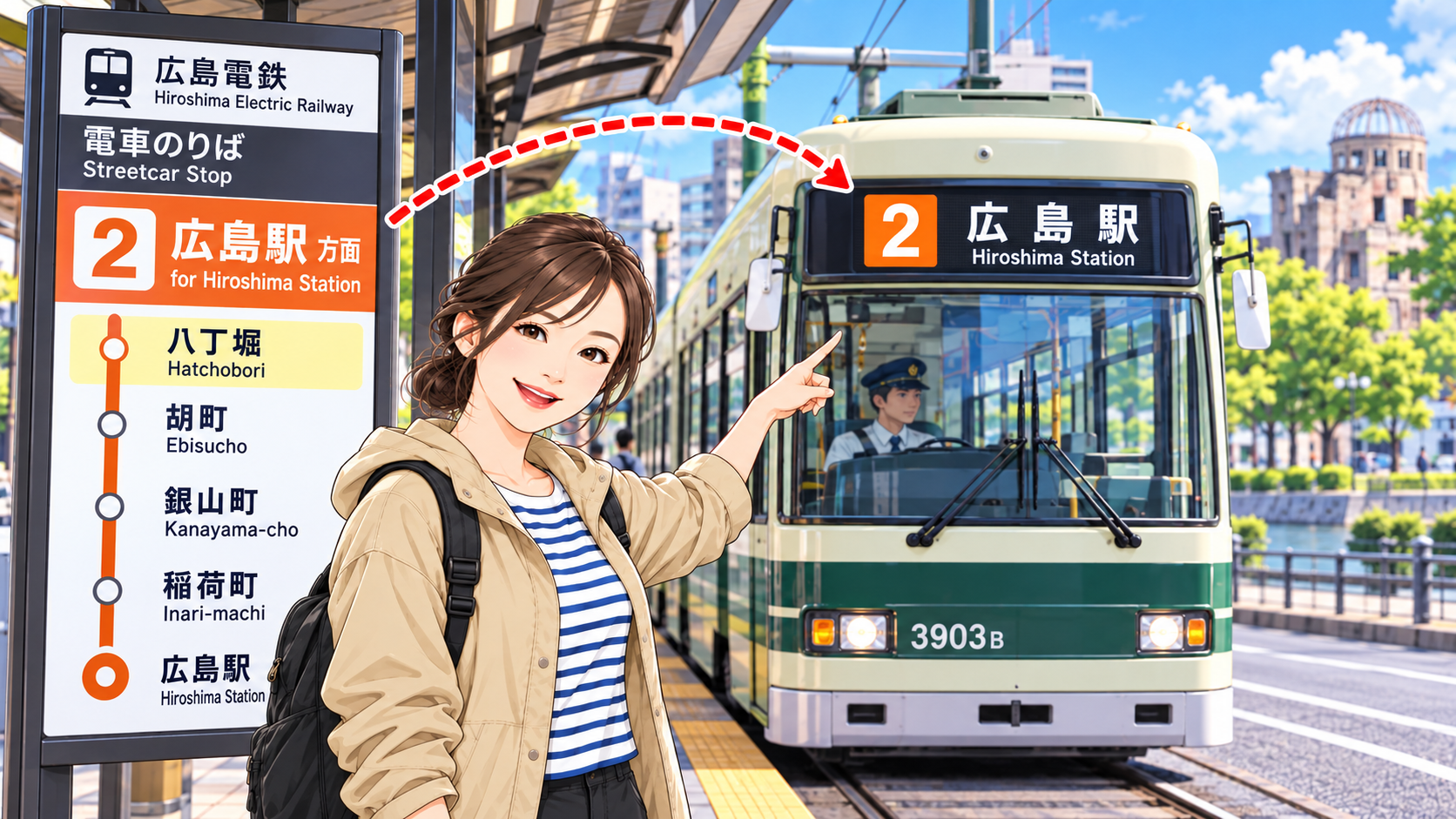
Before boarding, check the route number and destination displayed on the front or side of the tram.
Compare them with the route map at the stop to make sure the tram serves your destination.
② Wait at the Correct Tram Stop
When you reach the stop, check the destination signs or route map to make sure the tram is traveling in the right direction.
Even when stops have the same name, trams heading the other way may depart from the opposite side of the road.
If the tram stop is in the middle of the road, use a nearby crosswalk if there is one.
If there is no crosswalk, avoid places where crossing is prohibited. Check carefully for approaching cars and bicycles, and cross safely.
Don’t suddenly run into the road to catch a tram. It’s dangerous.
③ Board Through the Designated Door
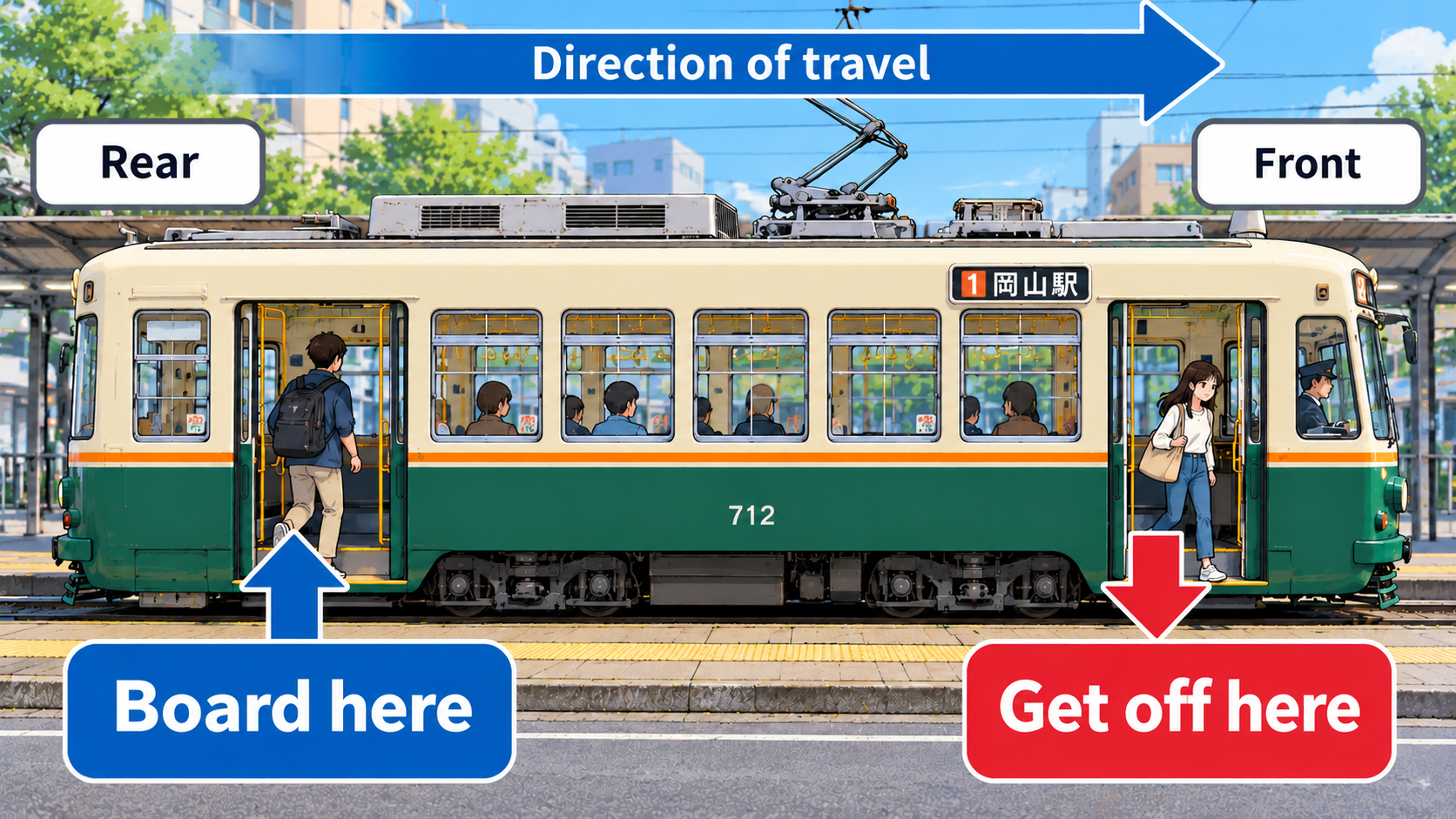
On some trams, the boarding and exit doors are separate.
Many trams use the middle or rear doors for boarding and the front door for getting off.
However, in Hiroshima you can board through any door, and on Kumamoto’s ultra-low-floor trams you can board through either the front or rear door.
If signs near the doors say “入口” (Entrance) or “出口” (Exit), follow them.
What you need to do when boarding also depends on how you plan to pay.
- Cash: In many cities, you can simply board, but some places, such as Hakodate, require you to take a numbered ticket.
- Transit IC card: Some cities require a tap when boarding, while others only require a tap when you get off.
- Contactless credit card: On supported trams, tap your card or smartphone on the dedicated reader. Whether you also need to tap when boarding depends on the city.
For example, in Hiroshima and Kumamoto, you can board without paying or taking a numbered ticket when using cash. In Hakodate, you take a numbered ticket as you board.
You can also pay by contactless credit card in cities such as Nagasaki, Kumamoto, Kagoshima, and Sapporo.
However, this payment method is not available on every tram in Japan.
④ Watch for Your Stop and Press the Stop Button if Needed
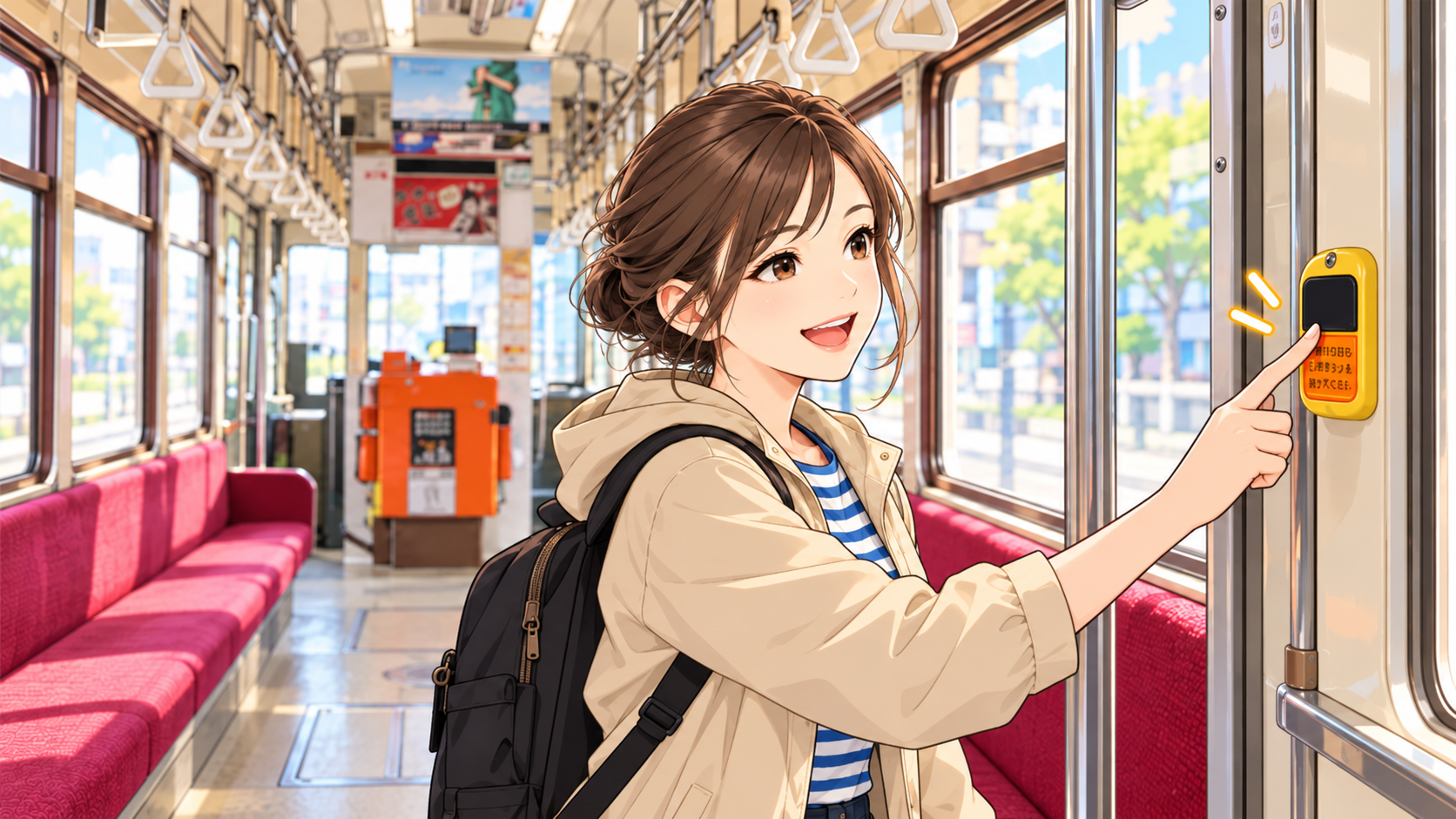
On board, the next stop is announced.
Some trams also show the stop name on a display. Check it against the stop you looked up before boarding.
When your destination is approaching, press the stop request button inside the tram.
If the tram doesn’t have a stop button, use the announcements and stop displays to identify where to get off. Wait until the tram has stopped and the doors have opened before exiting.
⑤ Pay Your Fare and Get Off
On many Japanese trams, you pay when getting off.
If you’re paying cash, put the money in the fare box. If you’re using a transit IC card, tap it on the designated reader.
For contactless credit card payments, use the dedicated credit card reader.
Transit IC cards and contactless credit cards use different readers.
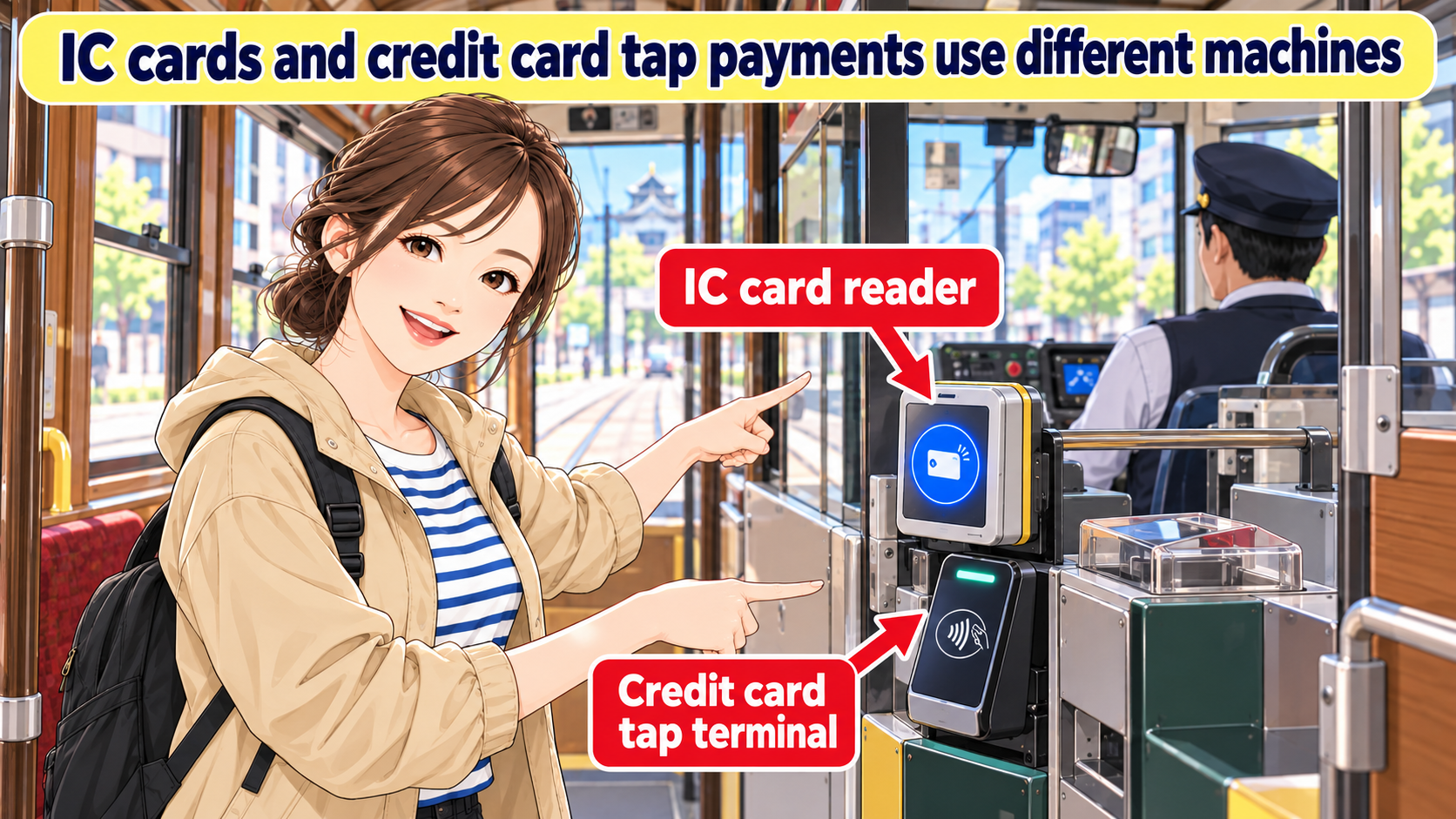
Reader designs and locations vary by tram operator.
If there are separate readers, be careful to use the right one.
The doors you can use to get off also vary by city and payment method.
Once you’ve paid, get off through the designated door.
3 Ways to Pay for Trams in Japan
The main ways to pay for trams in Japan are cash, transit IC cards, and contactless credit cards.
Here’s how each one works and what to watch out for.
1. Pay with Cash
You can pay cash for a tram ride in Japan.
However, when you pay and whether you need a numbered ticket depend on the city.
In cities with flat fares, you pay the same amount regardless of how far you ride.
In others, such as Hakodate, the fare depends on the distance traveled.
On trams where you pay cash when getting off, put the required amount into the fare box along with your numbered ticket, if you have one.
Some lines are exceptions. On the Tokyu Setagaya Line, for example, you pay when boarding.
Tram fare boxes generally don’t give change.
For example, if your fare is ¥200 and you put a ¥500 coin directly into the fare box, you won’t get ¥300 back.
If you don’t have the exact fare, use the change machine near the fare box before paying.
However, there are restrictions on which bills these machines can change.
On many trams, you can’t change ¥5,000 or ¥10,000 bills on board.
If you’re paying cash, we recommend bringing coins, such as ¥100 coins, or ¥1,000 bills.
For safety, only use the on-board change machine while the tram is stopped.
2. Pay with a Transit IC Card Such as Suica, PASMO, or ICOCA
Suica, PASMO, and ICOCA are transit IC cards widely used on trains, buses, and other public transportation in Japan.
You can also use them on trams that accept them.
However, Suica, PASMO, and ICOCA are not accepted on every tram in Japan.
For example, you can use them in Hiroshima, Nagasaki, and Kumamoto, but not on Kagoshima’s trams. (You’ll find details on which cities accept them below.)
Some cities require you to tap both when boarding and when getting off, while others only require a tap when getting off.
If you’re using a transit IC card, check whether you need to tap when boarding.
Readers may be installed at tram stops or station ticket gates as well as inside the tram. On routes that require a tap when boarding, use the designated reader.
If your card balance is low, we recommend topping it up before boarding.
Some tram operators don’t let you top up nationwide-compatible transit IC cards on board.
3. Pay with a Contactless Credit Card
More trams in Japan are starting to accept contactless credit card payments.
On supported routes, you can pay with a contactless-enabled credit card or a smartphone with an accepted card registered on it.
It’s convenient not having to buy a new transit IC card or top it up in advance.
For example, contactless credit card payments are accepted in Nagasaki, Kumamoto, Kagoshima, and Sapporo.
However, when you need to tap varies.
In Nagasaki and Kagoshima, you tap both when boarding and getting off. In Sapporo and Kumamoto, you normally tap only when getting off.
In cities where you must tap both when boarding and getting off, use the same card or the same payment device, such as your smartphone, for both taps.
Even if you’ve added the same credit card to your smartphone, the physical card and your phone may be treated as separate payment devices.
Accepted credit card brands also vary by operator.
You can access each operator’s official website through the “Check Payment Methods for Trams and LRT Across Japan” table at the beginning or end of this article.
Check the city’s official information to see whether your card brand is listed, and make sure your card supports contactless payments.
City-by-City Comparison: Tram Fares and IC Card Use
This is one of the most important things to know when riding trams in Japan.
We compared seven cities that tourists may visit, based on official information as of October 2026.
| City | Regular Adult Fare | Suica and Similar Cards | Contactless Credit Card |
|---|---|---|---|
| Sapporo | ¥230 | ○ | ○ |
| Hakodate | ¥250–¥300 | ○ | — |
| Okayama | ¥160 | ○ | — |
| Hiroshima | ¥240 | ○ | — |
| Nagasaki | ¥150 | ○ | ○ |
| Kumamoto | ¥200 | ○ | ○ |
| Kagoshima | ¥200 | × | ○ |
Note: Fares in Hakodate vary by distance traveled.
Note: ○ = Accepted; × = Not accepted; — = Direct contactless credit card payments on board could not be confirmed through official information.
Note: Contactless credit card payment means paying the fare by tapping an accepted credit card directly on a dedicated reader on board. This does not include purchasing a ticket with a credit card.
Note: When to tap your IC card or credit card varies by city. See the city-specific guides below for details.
What to Know in Hiroshima, Nagasaki, Kumamoto, Kagoshima, and Other Cities
Here’s what the differences mean when you actually ride a tram in each city.
Hiroshima: Tap Your Transit IC Card When Boarding and Getting Off
Hiroshima Electric Railway trams are convenient for visiting places such as the Atomic Bomb Dome and Peace Memorial Park.
The regular adult fare is ¥240. You can also use transit IC cards such as Suica, PASMO, and ICOCA.
However, the way you use transit IC cards changed on July 1, 2026.
You now tap your card on a MOBIRY DAYS reader both when boarding and when getting off.
You can board through any door, whether you’re paying cash or using an IC card.
When getting off, however, the rules depend on how you’re paying.
- Paying one adult fare with a transit IC card: As a rule, you can get off through any door
- Paying cash: Get off through the designated exit, such as a door attended by a crew member
- Paying for multiple passengers or a child fare with an IC card: Speak to the crew member at the attended door
You can’t top up transit IC cards such as Suica on Hiroshima Electric Railway trams.
If your balance is low, top it up at a station or another charging location before boarding.
Watch out for travel articles that explain boarding and payment procedures from before July 2026.
| City | Regular Adult Fare | Suica and Similar Cards | Credit Card Accepted | IC Card Tap | Contactless Credit Card |
|---|---|---|---|---|---|
| Hiroshima | ¥240 | ○ | Not confirmed | Boarding & exiting | — |
Nagasaki: Tap Both IC Cards and Credit Cards When Boarding and Getting Off
Nagasaki’s trams are convenient for visiting Peace Park, the Atomic Bomb Museum, Dejima, and Nagasaki Shinchi Chinatown.
The regular adult fare is a flat ¥150.
If you’re paying cash, board through the middle or rear door and pay at the front door when getting off. You don’t need a numbered ticket.
If you’re using a transit IC card such as Suica, PASMO, or ICOCA, tap it both when boarding and when getting off.
For contactless credit card payment, you also need to tap both when boarding and when getting off.
Transit IC cards and credit cards use different readers, so make sure you use the right one.
For credit cards, use the same card or the same smartphone when boarding and when getting off.
Get off through the front door.
| City | Regular Adult Fare | Suica and Similar Cards | Credit Card Accepted | IC Card Tap | Contactless Credit Card |
|---|---|---|---|---|---|
| Nagasaki | ¥150 | ○ | ○ | Boarding & exiting | Boarding & exiting |
Kumamoto: Suica Works on City Trams; Tap Your IC Card When Getting Off
Kumamoto City Trams are convenient for traveling from Kumamoto Station toward Kumamoto Castle or Suizenji Park.
The regular adult fare is a flat ¥200.
Transit IC cards such as Suica, PASMO, and ICOCA are accepted.
Normally, you board through the middle or rear door and tap your IC card when getting off.
On ultra-low-floor trams, you can board through either the front or rear door.
Contactless credit cards are also accepted, and you can normally pay with just one tap when getting off.
| City | Regular Adult Fare | Suica and Similar Cards | Credit Card Accepted | IC Card Tap | Contactless Credit Card |
|---|---|---|---|---|---|
| Kumamoto | ¥200 | ○ | ○ | Exiting only | Exiting only |
Although Kumamoto City Trams accept Suica, PASMO, ICOCA, and similar cards, major local bus routes in Kumamoto do not.
They stopped accepting nationwide-compatible transit IC cards on November 16, 2024.
Kagoshima: Suica Isn’t Accepted, So Bring Cash
Kagoshima’s trams are convenient for getting around downtown areas such as Kagoshima-Chuo Station and Tenmonkan.
The regular adult fare is ¥200.
Here’s something important to remember: Kagoshima’s trams don’t accept nationwide-compatible transit IC cards such as Suica, PASMO, or ICOCA.
Kagoshima also has its own local IC card called Rapica.
However, buying one requires a ¥500 deposit, and you must apply for a refund at a service counter and pay a ¥210 fee.
If you’re visiting Japan for a short trip, we recommend paying cash or using an accepted contactless credit card instead of buying one.
Board through the middle door and get off through the front door.
If you’re paying cash, there’s nothing to do when boarding. Just put ¥200 into the fare box when getting off.
If you’re using a contactless credit card, tap it on the dedicated reader near the middle door when boarding, then tap it again on the reader at the front when getting off.
Contactless credit cards are accepted, but bring cash as well in case a payment error occurs.
You can’t change ¥5,000 or ¥10,000 bills on board, so it’s a good idea to have coins such as ¥100 coins or a ¥1,000 bill ready.
| City | Regular Adult Fare | Suica and Similar Cards | Credit Card Accepted | IC Card Tap | Contactless Credit Card |
|---|---|---|---|---|---|
| Kagoshima | ¥200 | × | ○ | — | Boarding & exiting |
Sapporo: Tap IC Cards and Credit Cards When Getting Off
Sapporo’s tram runs on a loop route through the city.
The regular adult fare is ¥230.
Transit IC cards such as Suica, PASMO, and ICOCA are accepted.
Board through the rear door and get off through the front. You don’t need to take a numbered ticket or tap your IC card when boarding.
Tap your transit IC card when getting off.
Contactless credit card payments also became available on April 27, 2026.
You can pay this way with just one tap when getting off, too.
There’s nothing to do when boarding. When getting off, tap the reader for your chosen payment method.
If you’re paying cash, there’s nothing to do when boarding either. Put your fare into the fare box at the front when getting off.
| City | Regular Adult Fare | Suica and Similar Cards | Credit Card Accepted | IC Card Tap | Contactless Credit Card |
|---|---|---|---|---|---|
| Sapporo | ¥230 | ○ | ○ | Exiting only | Exiting only |
Hakodate: Take a Numbered Ticket When Paying Cash
Hakodate’s trams can take you from Hakodate Ekimae tram stop (in front of Hakodate Station) toward Goryokaku-Koen-Mae or the Yunokawa Onsen area.
Adult fares in Hakodate vary by distance, ranging from ¥250 to ¥300.
If you’re paying cash, board through the middle door and take a numbered ticket from the machine by the entrance.
When getting off, match the number on your ticket with the fare display inside the tram to check how much you need to pay.
Put your numbered ticket and cash into the fare box at the front, then get off.
Suica, PASMO, ICOCA, and similar cards are also accepted.
If you’re using a transit IC card, don’t take a numbered ticket. Tap your card on the reader when boarding.
Tap the reader at the front again when getting off to pay.
| City | Regular Adult Fare | Suica and Similar Cards | Credit Card Accepted | IC Card Tap | Contactless Credit Card |
|---|---|---|---|---|---|
| Hakodate | ¥250–¥300 | ○ | Not confirmed | Boarding & exiting | — |
Okayama: Flat ¥160 Fare; Tap Your IC Card When Boarding, Too
Okayama’s trams are convenient for traveling from Okayama Ekimae tram stop (in front of Okayama Station) toward Okayama Castle and Korakuen Garden.
Since October 2025, the regular adult fare has been a flat ¥160 on all routes.
As a rule, you board through the rear door and get off through the front.
However, at the first stop on a route, you can board through any door.
You don’t need a numbered ticket when paying cash. Pay ¥160 when getting off.
Transit IC cards such as Suica, PASMO, and ICOCA are accepted, too.
If you’re using an IC card, tap it both when boarding and when getting off.
You also can’t top up nationwide-compatible transit IC cards such as Suica and ICOCA on Okayama trams.
If you don’t have enough balance, you’ll need to pay cash.
| City | Regular Adult Fare | Suica and Similar Cards | Credit Card Accepted | IC Card Tap | Contactless Credit Card |
|---|---|---|---|---|---|
| Okayama | ¥160 | ○ | Not confirmed | Boarding & exiting | — |
What If Something Goes Wrong on a Tram?
When it’s your first time riding, an IC card or credit card error can be confusing.
Here are answers to some common questions.
What If You Forget to Tap Your IC Card?
If you forget to tap when boarding in a city where it’s required, tell a crew member before getting off.
Tapping repeatedly on your own may prevent your trip record from being processed correctly.
You can say:
“I forgot to tap my IC card when I got on.”
Remember, for normal journeys in Sapporo and Kumamoto, you don’t need to tap your IC card when boarding.
What If Your IC Card Doesn’t Have Enough Balance?
If you get an insufficient-balance error when getting off, tell a crew member.
Depending on the city, you may need to settle the fare in cash or top up your card on board.
For example, on Kumamoto City Trams, you can top up a transit IC card using a ¥1,000 bill by asking a crew member while the tram is stopped.
In Hiroshima and Okayama, however, you can’t top up nationwide-compatible transit IC cards such as Suica on board.
The safest approach is to check your balance at a station or another charging location beforehand and top it up if needed.
What If Your Credit Card Doesn’t Work?
First, check whether your card has the contactless payment symbol.
Next, check whether the tram operator accepts your card brand.
Make sure you haven’t been tapping your credit card on a transit IC card reader.
If you’re paying with a smartphone, also check that you’ve selected the correct card.
If it still doesn’t work, speak to a crew member and pay using another accepted method.
What If You Board a Tram Going the Wrong Way?
First, check the route map inside the tram or the next-stop display.
If you realize you’re going in the wrong direction, get off at the next stop and board a tram going the right way.
As a rule, you’ll need to pay the fare when getting off the tram you boarded by mistake, and pay again for the tram you take afterward.
When moving to a stop on the opposite side of the road, use a crosswalk if there is one, and check your surroundings carefully before crossing.
Can You Bring a Suitcase on a Tram?
If you bring a suitcase on board, make sure it doesn’t block other passengers from moving around.
In particular, don’t block aisles or doorways with your luggage.
Some older trams have large steps that can make boarding and getting off difficult.
If you have a large suitcase, we recommend checking the service schedule for low-floor trams or avoiding busy times.
If your luggage is too large to carry safely on board, choose another form of transportation, such as a taxi.

What Are Trams in Japan, and Where Can You Ride Them?
Trams are trains that run on tracks on or alongside roads. They’re called “trams” or “streetcars” in English, and are also known as “shiden” (市電) in Japan.
They operate in various Japanese cities, including Hiroshima, Nagasaki, and Hakodate. Part of their routes runs along streets, and stops are generally fairly close together.
You can take them to attractions such as the Atomic Bomb Dome in Hiroshima, Peace Park in Nagasaki, or Goryokaku in Hakodate. Being able to see the city streets along the way is part of the appeal, too.
What to Remember Before Riding a Tram in Japan
Trams in Japan aren’t just a way to reach tourist attractions. They’re also a great way to enjoy the atmosphere of a city.
When riding in a city for the first time, check these things in order:
- Destination: Check the route number and the stop for where you’re going
- Boarding door: Check which door to use to get on
- Payment method: Check whether Suica or a credit card is accepted, and when to tap
- Getting off: Signal when you’re approaching your stop and pay the fare in the required way
The main thing to remember is that even in cities where you can use transit IC cards such as Suica, the way you use them isn’t always the same.
In Hiroshima, Nagasaki, Okayama, and Hakodate, you tap when boarding and getting off. In Sapporo and Kumamoto, you normally tap only when getting off.
Kagoshima’s trams don’t accept nationwide-compatible transit IC cards at all.
If you’re visiting a city for the first time, check whether your IC card is accepted and when you need to tap it before boarding.

Riding a tram can be part of the fun of traveling in Japan, too. Enjoy the city views and the journey to your destination. Woof!
🚋 Check Payment Methods for Trams and LRT Across Japan
Note: “Suica and similar cards” refers to transit IC cards that work across participating systems nationwide, including Suica, PASMO, and ICOCA.
Note: Contactless credit card payment means tapping an accepted credit card directly on a dedicated reader at a station or on board. This does not include buying tickets with a credit card at a ticket machine or in an app.
Note: ○ = Accepted; × = Not accepted; — = Direct contactless card payment could not be confirmed through official information.
Note: Links lead to official English pages where possible, though some are official Japanese-language pages. Check the relevant official page for final confirmation.
Note: Enoshima Electric Railway (Enoden) is a railway line rather than a typical tram service, but it is included because part of its route runs on the road. Boarding and exiting are handled at station ticket gates.
Note: This list covers trams, LRT systems, and certain rail lines with street-running sections, grouped by operator or route network. It does not list every individual service.
More Guides to Getting Around Japan